
If you’re wondering how to sell your house without a realtor in Orlando, you’re not alone. Every year, a portion of Orlando homeowners decide to go the For Sale By Owner (FSBO) route. The reason is almost always the same: skipping the listing agent commission sounds like an easy way to keep more money from the sale. It makes sense on the surface. But before you post that yard sign, it’s worth understanding what Florida law requires of you, what the process actually involves, and what the numbers say about how FSBO sales tend to play out.
I work with FSBO sellers and I’ve seen both outcomes. Some pull it off smoothly. Others hit walls they didn’t see coming. Here’s an honest look at both sides.
What FSBO Actually Means in Florida
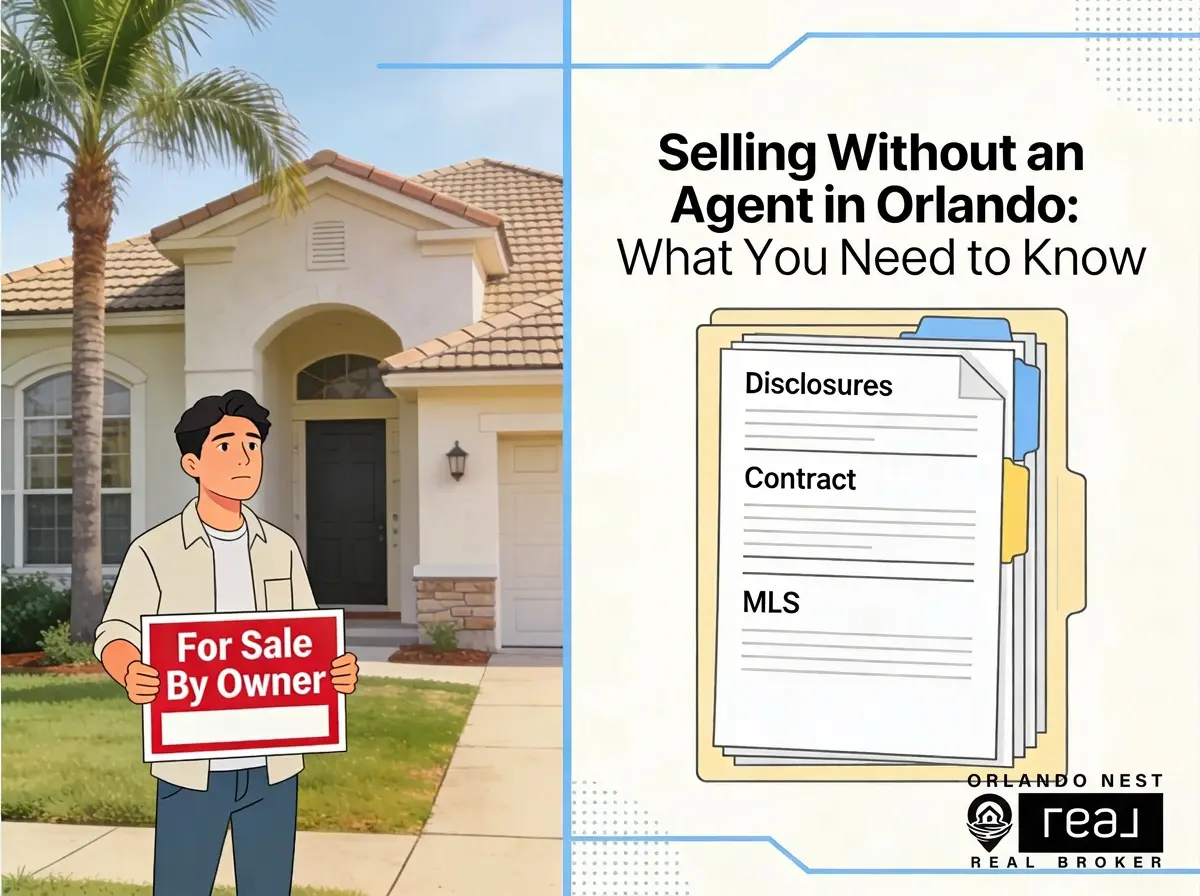
Selling FSBO means you take on every responsibility your listing agent would normally handle: pricing, photography, marketing, MLS access (or not), showing coordination, offer review, negotiation, contract management, disclosure compliance, and the coordination between title, lender, and closing attorney.
Florida does not require a real estate attorney to close a transaction, but it does require a licensed title company or attorney to handle the closing. You’ll need to hire one regardless of whether you use an agent.
Florida Disclosure Requirements Are Not Optional
This is the area where FSBO sellers most frequently run into legal trouble. Florida is a disclosure state. Under established Florida case law — going back to Johnson v. Davis — sellers must disclose all known facts that materially affect the value of the property and that aren’t readily observable by the buyer.
That means if you know about it, you have to disclose it. The requirement applies whether you’re selling with an agent or on your own, and it applies even in “as-is” sales.
Florida-specific disclosures you need to be aware of include:
- Known material defects (roof issues, plumbing, mold, structural problems)
- Flood risk and past storm damage
- HOA membership, fees, and any pending special assessments
- Sinkhole history or insurance claims
- Radon gas (required by statute prior to contract execution)
- Lead-based paint for homes built before 1978 (federal requirement)
- Pending code enforcement actions
Florida does not mandate a single standardized disclosure form, but the Florida Realtors® form is widely used and covers the required categories. You can review the full disclosure framework at the Florida Realtors® disclosure law library. Making disclosures verbally is technically allowed, but written disclosure is strongly recommended — if a dispute arises later, a verbal disclosure is nearly impossible to prove.
| Important Note: Approximately 77% of real estate lawsuits in Florida are tied to disclosure issues. If you’re selling without an agent, consulting a real estate attorney before listing is a smart investment — not an optional extra. |
The MLS Question
One of the biggest practical challenges for FSBO sellers is visibility. The MLS — the Multiple Listing Service — is where the vast majority of serious buyers and their agents are searching. Without MLS access, your home won’t appear on Zillow, Realtor.com, Redfin, or most buyer-facing search portals as a standard listing.
You can purchase a flat-fee MLS listing through a third-party service, which puts your property in the system without requiring you to hire a full-service agent. You’ll still need to manage everything else yourself, and you’ll typically need to offer a buyer’s agent commission or be prepared to navigate buyers who expect one as a seller concession.
What the Numbers Say
The data on FSBO outcomes is consistent enough to be worth taking seriously. According to the National Association of REALTORS® 2025 Profile of Home Buyers and Sellers, FSBO transactions fell to just 5% of all home sales last year — a historic low. At the same time, 91% of sellers worked with a licensed agent.
The price gap is significant. The median FSBO sale price last year was $360,000, compared to $425,000 for agent-assisted sales — a difference of $65,000. Even after accounting for a typical 3% listing commission on a $425,000 sale (~$12,750), the agent-assisted seller still nets roughly $52,000 more.
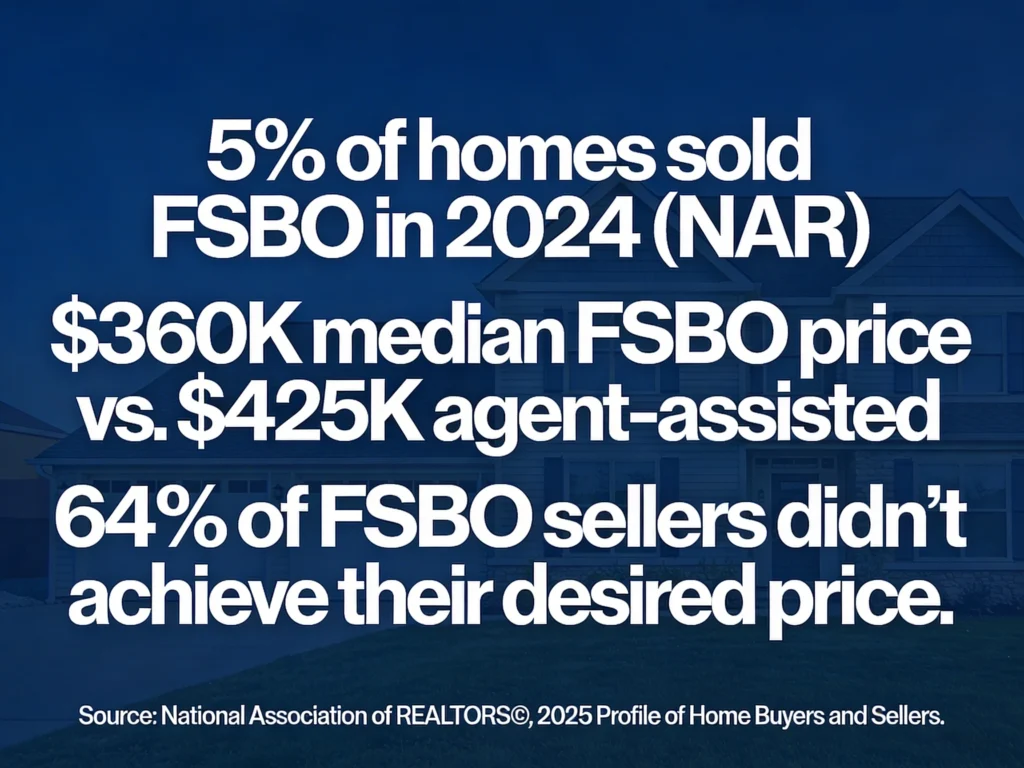
| By the Numbers (NAR 2025)• 5% of homes sold FSBO in 2024 — an all-time low• Median FSBO sale price: $360,000• Median agent-assisted sale price: $425,000• Price gap: $65,000 in favor of agent-assisted sales• 47% of FSBO sellers described the process as bringing them to tears• 64% said they did not achieve their desired sale price• 38% of FSBO sellers already had a buyer lined up before listing |
That last figure is important context. The FSBO model tends to work best when a seller already has a buyer — a family member, friend, or neighbor — and the transaction is essentially pre-negotiated. In that scenario, the seller saves on commission and the process is more straightforward. When there is no buyer lined up, the odds shift considerably.
When FSBO Makes Sense — And When It Doesn’t
FSBO is worth considering if you have a pre-identified buyer, strong comfort with contracts and negotiation, time to manage the process, and a solid read on current market pricing. In the right situation, the savings are real.
It’s a harder road if you’re navigating Orlando’s market without recent comparable sales data, if your home requires any negotiation around condition or inspection findings, or if you’re simultaneously managing a purchase (a situation that adds significant coordination complexity — more on that in our guide to
It’s a harder road if you’re simultaneously managing a purchase. That layered coordination is one of the trickiest parts of the process — we break it down fully in How to Buy and Sell a Home at the Same Time in Orlando.
What You’ll Still Pay Even Going FSBO
A common misconception is that FSBO means zero commissions. Here’s what you’ll still need to budget for:
- Title insurance and closing costs — typically 1–2% of the sale price
- Buyer’s agent commission — still commonly offered as a seller concession, typically 2.5–3%
- Flat-fee MLS listing — if you choose to use one, roughly $200–$500
- Professional photography — non-negotiable if you want competitive offers
- Real estate attorney review — strongly recommended given Florida’s disclosure landscape
- Home inspection and pre-listing repairs, if applicable
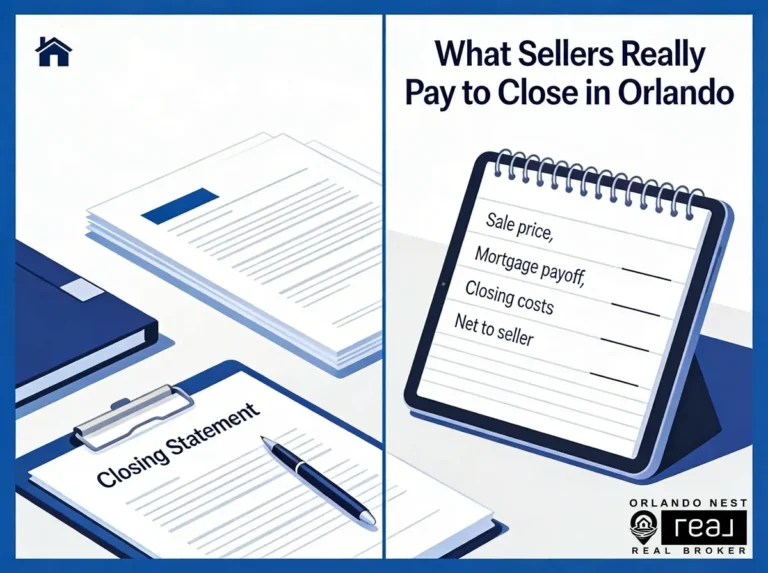
For a full breakdown of what sellers pay at the closing table, see What Are Closing Costs for Sellers in Florida.
A Middle Path Worth Knowing About
At OrlandoNest, we work with homeowners who want to explore every option before committing. If you’re weighing FSBO, we’re happy to walk you through current market data, what comparable homes have sold for recently, and what the process would look like — no obligation required. You can also request a free home evaluation to get a current picture of your home’s value before you decide anything.
We also have a dedicated FSBO page at OrlandoNest that explains how we assist sellers who want some support without a full listing agreement. If you’d prefer to talk it through directly, you can schedule a no-pressure conversation here.
Do I have to use a real estate agent to sell my house in Florida?
No. Florida law does not require you to hire a real estate agent to sell your home. You can sell your property yourself as a For Sale By Owner (FSBO) seller. However, you are still legally required to disclose all known material defects to the buyer, and you’ll need a licensed title company or closing attorney to handle the closing. Many FSBO sellers also benefit from consulting a real estate attorney, especially around contract drafting and disclosure compliance.
What disclosures am I required to make when selling my Orlando home without an agent?
Florida sellers must disclose all known facts that materially affect the property’s value and that aren’t easily visible to a buyer. This applies whether you have an agent or not. Required disclosures typically include material defects (roof, plumbing, structural issues), flood history, HOA information, sinkhole history, radon gas, and — for homes built before 1978 — lead-based paint. Florida does not require a single standardized form, but using the Florida Realtors® Seller’s Property Disclosure form is strongly recommended. Selling as-is does not eliminate your disclosure obligations.
How much do FSBO homes typically sell for compared to agent-listed homes in Orlando?
Nationally, the gap is significant. According to the NAR’s 2025 Profile of Home Buyers and Sellers, the median FSBO sale price was $360,000, compared to $425,000 for agent-assisted sales — a $65,000 difference. In suburban markets like Orlando, where agent representation is even higher than average, FSBO homes face a steeper competitive disadvantage. Even after accounting for a listing agent’s commission, most sellers net more through an agent-assisted sale than they would going it alone.
Do I still have to pay a buyer’s agent commission if I sell FSBO?
Not by law — but in practice, most FSBO sellers still offer a buyer’s agent commission or negotiate it as a seller concession. Following the 2024 NAR settlement, sellers can no longer advertise buyer agent compensation within MLS listings, but buyers may still request it as part of their offer. If you decline to offer any compensation to buyer’s agents, some agents may discourage their clients from viewing your home. It’s a factor worth factoring into your cost-benefit analysis before deciding to go FSBO.
What’s the difference between listing FSBO on Zillow vs. paying for a flat-fee MLS listing in Florida?
A Zillow FSBO listing is free and appears on Zillow’s platform, but it will be marked as a FSBO listing rather than a standard agent listing, and it will not appear on the MLS or syndicate to all agent-facing portals. A flat-fee MLS listing — purchased through a licensed Florida broker for typically $200–$500 — gets your property into the MLS database, which is where buyer’s agents search and where sites like Realtor.com and Redfin pull their data. Most real estate professionals recommend the flat-fee MLS route for FSBO sellers who want maximum buyer exposure without a full-service agent.
Can I sell my home FSBO while also buying a new home in Orlando at the same time?
Yes, but it significantly increases the complexity of both transactions. Coordinating closing dates, contingencies, and financing timelines without an agent requires careful planning. Many sellers who attempt this discover mid-process that the coordination demands are higher than anticipated. If you’re in this situation, our guide to buying and selling at the same time in Orlando walks through the key scenarios and decision points.
Ted’s Take
I’ve worked with a handful of FSBO sellers who pulled it off beautifully — every one of them already had a buyer lined up before the sign hit the yard. The ones who called me three weeks later? They’d already had one deal fall apart, two lowball offers, and a buyer’s agent who hadn’t returned a call in a week. Florida’s disclosure requirements alone are enough to make a grown adult want to lie down on the floor — which, coincidentally, is also a required disclosure if the floor has structural issues. And there’s the Flood Disclosure which quietly became law that applies to all sales in October of 2025….
Ted Moseley is a Central Florida REALTOR® with Orlando Nest – Real Broker, LLC, helping buyers and sellers make clear, data-driven decisions across Orlando, Winter Park, Lake Nona, College Park, and surrounding neighborhoods.
Explore: Market Update · Home Value · Sell a Home · Reviews · More Articles
Have a question about timing, pricing, or next steps? Schedule a quick 30-minute call →
© Ted Moseley – Orlando Nest – Real Broker, LLC