
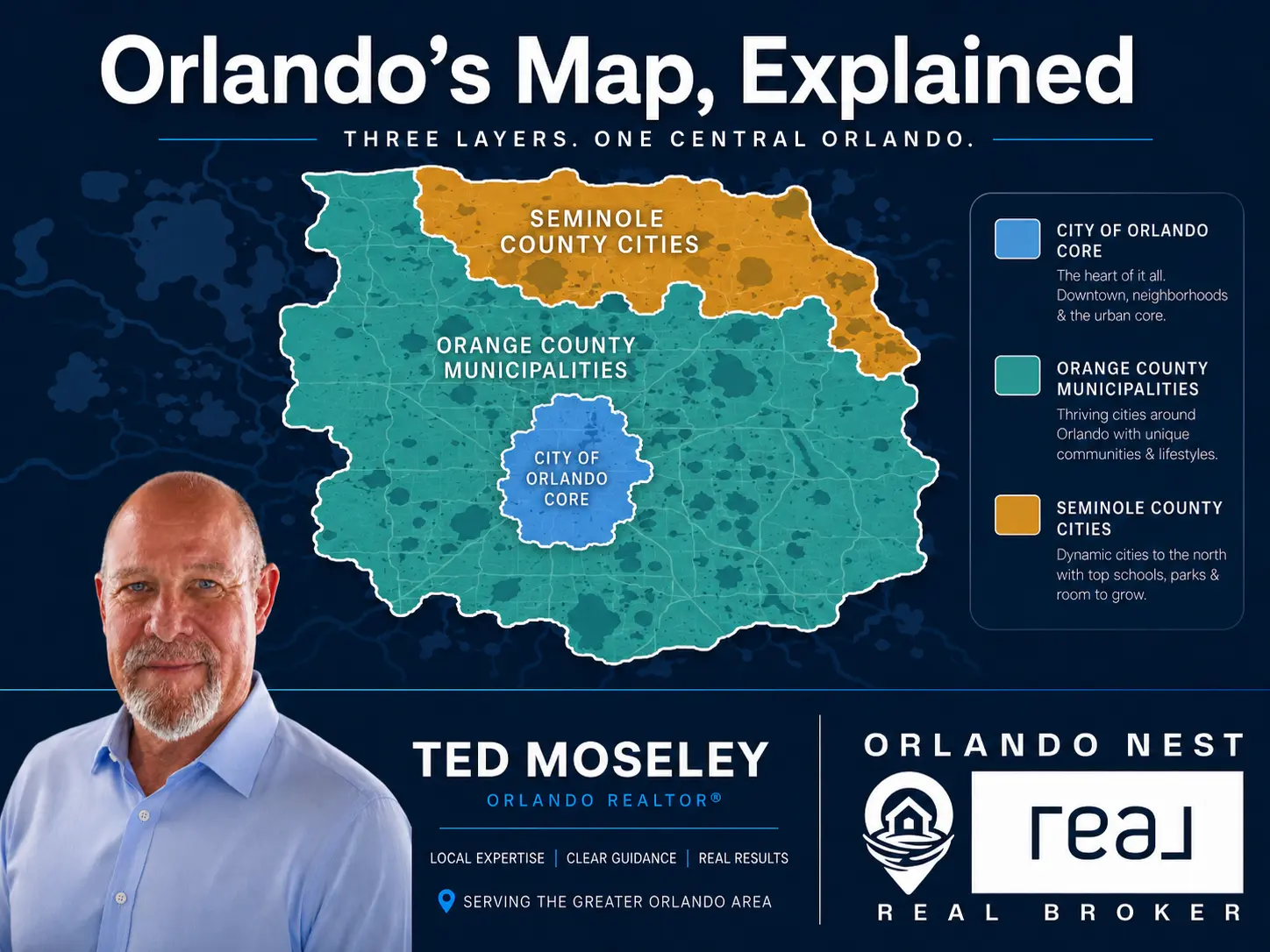

If you’ve started researching a move to Central Florida, you’ve probably noticed that “Orlando” seems to mean about six different things depending on who you ask. A job listing says Orlando. The neighborhood you’re looking at says Winter Park. Your coworker who moved here two years ago keeps talking about “Kissimmee.” – that’s where most of Disney’s property is located – the Zillow map just says Orange County – which is even more confusing to many folks relocating here because Kissimmee is actually in Osceola County!
None of these are wrong. They’re just describing different layers of the same place. Here’s how to make sense of all of it before you start house hunting. This brief primer should help answer some of the most commonly asked questions about how Orlando is organized.
Start Here: The City of Orlando Is Smaller Than You Think
The City of Orlando is an incorporated municipality covering roughly 110 square miles and about 320,000 residents. That’s it. It has its own mayor, its own city council, its own police department, and its own zoning rules.
But when most people say “Orlando,” they mean something much larger — the broader metro area that includes dozens of surrounding cities, towns, and unincorporated communities, most of which are their own separate governments and have nothing to do with Orlando’s city hall.
If you’re relocating here, the distinction matters more than you’d expect — because your property taxes, school districts, utility providers, and local government services all depend on exactly where your address falls, not on the general “Orlando” label.
Orange County: The Foundation
Most of what people think of as Orlando sits within Orange County, Florida. The county covers about 900 square miles of land and as of the 2025 Census Bureau estimate, is home to roughly 1.5 million people. It’s the fifth-most populous county in Florida.
Orange County contains 13 incorporated municipalities — meaning cities and towns with their own elected governments. The ones most relevant to home buyers in OrlandoNest’s service area include:
- City of Orlando — The county seat. Downtown, Milk District, College Park, and many established neighborhoods fall within city limits.
- Winter Park — An independent city with its own government, school system, and character. Not a neighborhood of Orlando, even though it’s directly adjacent.
- Maitland — A small incorporated city north of Orlando, known for quiet residential neighborhoods and easy I-4 access.
- Winter Garden — A fast-growing city on the western edge of Orange County, with a well-regarded downtown and significant new development.
- Windermere — A small incorporated town known for luxury waterfront homes and high-profile residents.
What “Unincorporated Orange County” Actually Means
Here’s where it gets interesting. A large portion of Orange County — including some of its most popular and populous areas — is not inside any city. These are unincorporated communities, governed directly by Orange County rather than by a municipality.
Unincorporated communities don’t have their own mayors or city councils. Your local government is the Orange County Board of County Commissioners. Property taxes go to the county. Your roads, code enforcement, and zoning are county-administered.
Some of the largest unincorporated communities in Orange County include:
- Alafaya — A census-designated place in East Orange County with a 2020 population of over 92,000, making it larger than most incorporated cities in the area. This is where you’ll find Waterford Lakes, Avalon Park, and communities near UCF.
- Pine Hills — An unincorporated community northwest of Orlando with approximately 66,000 residents.
- Dr. Phillips — An unincorporated community in southwest Orange County, known for Restaurant Row and upscale residential areas near Bay Hill.
- Horizon West — A fast-developing planned community in western Orange County, built around a series of village centers.
- Lake Nona — Within Orlando city limits but often treated as a distinct community. Home to Medical City, the VA hospital, and a major planned community.
The key takeaway: when a listing says “Orlando, FL,” the property might be inside city limits, or it might be unincorporated Orange County using Orlando as the mailing address. Those are two different things with different implications for your taxes and services.
Seminole County: The Northern Half of the Story
Immediately north of Orange County is Seminole County, which is also part of OrlandoNest’s service area. Seminole County is smaller in geographic size but densely developed and home to about 470,000 residents.
Unlike the split between incorporated and unincorporated areas in Orange County, Seminole County is almost entirely incorporated. The seven incorporated cities in Seminole County that home buyers commonly consider include:
- Oviedo — A family-oriented city in eastern Seminole County known for good schools, a small-town feel, and easy access to the 417 toll road.
- Winter Springs — A bedroom community bordering Oviedo, with a mix of established neighborhoods and newer construction.
- Casselberry — A smaller city near the Orange/Seminole border, with more affordable price points and access to major employment corridors.
- Altamonte Springs — A suburb with strong retail infrastructure and one of the better-connected locations for commuting throughout the metro.
- Longwood — An established community between Altamonte Springs and Sanford, with a range of housing from older ranch-style homes to newer developments.
- Lake Mary — Positioned as Seminole County’s corporate hub, with a significant office and tech employment base along the I-4 corridor.
- Sanford — The Seminole County seat, located on Lake Monroe, with a revitalized historic downtown and growing residential interest.
How Orlando is Organized: The Greater Orlando / MSA Layer
Above all of this is “Greater Orlando” — a term with no legal meaning but significant practical use. The official U.S. government definition is the Orlando–Kissimmee–Sanford Metropolitan Statistical Area, which is a four-county region covering Orange, Seminole, Lake, and Osceola counties. Its 2020 Census population was 2.67 million, making it the 22nd-largest metro area in the United States.
When employers talk about the “Orlando job market” or when economic data references “Orlando real estate,” they’re typically talking about this MSA or some version of it. It’s a useful frame for understanding regional trends, but it doesn’t tell you which government will fix your pothole.
Why This Matters for Your Home Search
Understanding the layers of Orlando’s geography helps you ask better questions during your search:
- A home listed as “Orlando, FL” in Maitland is governed by the City of Maitland, not Orlando.
- A home listed as “Orlando, FL” in unincorporated Orange County pays county millage rates, not city rates.
- Oviedo and Winter Springs are in Seminole County — different school district from Orange County even if they feel geographically close.
- Some communities straddle county lines, which can affect school assignments even within the same neighborhood.
If you want a deeper breakdown of what living in each specific area actually looks like — schools, commute patterns, home prices, and character — our neighborhood guides cover many of the most common destinations. For a broader view of which areas are growing fastest and why, see our Relocation Guide.
Questions about a specific address or community? That’s exactly the kind of thing I help with every day. You can schedule a no-pressure conversation to talk through what matters most to you and where it realistically exists in this market.
Frequently Asked
Is Orlando a city or a county?
Orlando is an incorporated city — specifically, the county seat of Orange County, Florida. Orange County is the county. The City of Orlando covers approximately 110 square miles within Orange County and has its own mayor, city council, and municipal services. However, a large portion of what people casually call “Orlando” is actually unincorporated Orange County, using Orlando as a mailing address but governed by county rather than city government.
What’s the difference between Orlando and Greater Orlando?
The City of Orlando is a single incorporated municipality with a population of roughly 320,000. Greater Orlando — officially the Orlando–Kissimmee–Sanford Metropolitan Statistical Area — is a four-county region encompassing Orange, Seminole, Lake, and Osceola counties, with a combined population of over 2.6 million as of the 2020 U.S. Census. “Greater Orlando” has no legal government; it’s a Census Bureau designation used for economic and demographic reporting.
What cities are in Orange County Florida?
Orange County contains 13 incorporated municipalities, including the City of Orlando, Winter Park, Maitland, Apopka, Ocoee, Winter Garden, Windermere, Belle Isle, Bay Lake, Lake Buena Vista, Edgewood, Eatonville, and Oakland. The county also includes numerous large unincorporated communities — like Alafaya, Pine Hills, Dr. Phillips, and Horizon West — that use city-sounding names but are governed directly by the county rather than by independent municipal governments.
Is Oviedo part of Orlando?
No. Oviedo is an incorporated city in Seminole County, which is a separate county from Orange County (where Orlando is located). Oviedo is part of the Greater Orlando metro area and uses 407 area codes, but it has its own city government, school district (Seminole County Public Schools), and municipal services. It is not a neighborhood of Orlando, even though the two are geographically close.
What is unincorporated Orange County?
Unincorporated Orange County refers to areas within Orange County that are not part of any incorporated city or town. These areas are governed directly by the Orange County Board of County Commissioners rather than by a municipal government. Many well-known communities in the Orlando area are actually unincorporated — including Alafaya (which includes Waterford Lakes and Avalon Park), Dr. Phillips, Pine Hills, and Horizon West. Residents of these areas often use “Orlando” as their mailing address, which can create confusion about which government actually serves them.
What counties make up the Orlando metro area?
The Orlando–Kissimmee–Sanford Metropolitan Statistical Area, as defined by the U.S. Office of Management and Budget, includes four counties: Orange, Seminole, Lake, and Osceola. Orange County is the largest by population and contains the City of Orlando. Seminole County is directly north of Orange County and includes cities like Oviedo, Winter Springs, Altamonte Springs, and Lake Mary. Lake County is to the northwest and Osceola County is to the south, including Kissimmee and St. Cloud.
Are Winter Park and Orlando the same?
No. Winter Park is an independent incorporated city with its own mayor, city commission, police department, fire department, and utility systems. It is directly adjacent to Orlando and is often perceived as a neighborhood of Orlando by people unfamiliar with the area, but it operates as a completely separate municipal government. Winter Park is known for its brick-lined streets, Park Avenue, and Rollins College, and it consistently commands a premium in the real estate market compared to comparable properties just across the city line.
Ted’s Take
The most common version of this conversation I have: someone calls from out of state, says they want to live “in Orlando,” and within five minutes it’s clear they actually want to be in Oviedo, which is in a different county with a different school district, different tax structure, and a different government than the “Orlando” they Googled. None of that is a dealbreaker — Oviedo is a great place to land. But “Orlando” is a placeholder, not a destination. The faster you know the difference between the city, the county, and the metro, the faster you can stop searching generically and start searching for what actually fits your life.