
At a Glance
Oviedo is a Seminole County city of roughly 41,000 people sitting northeast of Orlando, about 5 miles from the University of Central Florida. Living in Oviedo FL means living in a city that is known for top-rated Seminole County schools, genuine suburban character, and one of the most remarkable origin stories in Central Florida — a history rooted in Slovak immigration, celery farming, and the stubborn optimism of one family who built an American agricultural empire from 40 acres of Florida scrubland. Today, Oviedo offers a range of homes from mid-century ranch styles to newer master-planned communities, with a median home value near $490,000-$500,000. It consistently ranks as one of the most livable communities in the Orlando metro.
A Town Built on Grit, Faith, and Celery
Oviedo’s story doesn’t begin with a developer’s master plan or a highway interchange. It begins in the 1870s, when early settlers around Lake Jesup scratched out a rough living in Central Florida’s swampy interior. By the late 1870s, the settlement needed a post office. Andrew Aulin, an early merchant, gave it a name: Oviedo — after the ancient university city in northern Spain, chosen simply because it sounded distinctive.
Early Oviedo was citrus country. The land around Lake Jesup proved well-suited for grapefruit and oranges, and by 1915 local farmers were shipping more than 60,000 boxes of citrus by rail annually. But Florida weather is not sentimental. A series of severe freezes in the 1890s wiped out crops and forced the community to rethink everything.
The Slavic Roots of Oviedo’s Celery Capital Era
Here is where the story gets extraordinary. In 1911, a group of Slovak Lutheran immigrants from Cleveland, Ohio — uncomfortable with industrial city life and determined to raise their children on the land — pooled resources through the Holy Trinity Slovak Lutheran Church and purchased 1,200 acres southwest of Oviedo for $17,400. Their guiding motto was Spat ku gazdovstvu — ‘Back to the farm.’
This settlement became Slavia, Florida. The founding families — Duda, Jakubcin, Mikler, Lukas, and others — arrived to find the land unsuited for citrus but surprisingly ideal for celery. The crop thrived in the wet, nutrient-rich soil, and a remarkable agricultural economy took root.
Among those earliest settlers was Andrew Duda, Sr., who arrived from Slovakia in 1909, settled briefly in Cleveland, then made the journey to Central Florida. After early setbacks and a return north to save money working in a factory, Duda came back to Slavia in 1926 and planted his first 40 acres of celery alongside his three sons — John, Andrew Jr., and Ferdinand — forming A. Duda and Sons.
The timing was improbable and the results were extraordinary. While much of the country descended into the Great Depression, the Duda celery operation not only survived but grew. By the 1920s, the area around Oviedo and neighboring Sanford was producing roughly a quarter of all marketable celery in the United States, earning the region the unofficial title of ‘Celery Capital of the USA.’ Refrigerated rail cars were the breakthrough technology that made it work — a game-changer the Duda family helped pioneer.
A. Duda and Sons eventually evolved well beyond celery. By the 1970s, the company diversified into commercial sod farming, and today Duda Farm Fresh Foods is an international agricultural company with operations across multiple states, still led by six generations of the Duda family. The original company building in Slavia still stands alongside St. Luke’s Lutheran Church, which the Duda family helped establish in 1939.
Lukas Nursery — the other great Slavia founding family enterprise — also still operates, having evolved from celery farming into one of Florida’s most beloved native plant nurseries and home to a significant butterfly conservatory. These are not historical footnotes. They are living institutions that trace their origins directly to that 1911 settlement on $17,400 worth of Florida scrubland.
What Living in Oviedo Actually Feels Like
Oviedo occupies a particular lane in the Orlando metro that’s hard to replicate: genuinely suburban without being distant or anonymous. The suburban character here feels earned — wide streets, mature trees, solid school zones — rather than the aspirational promise of a new interchange exit. You are close to UCF, the SR-417 Greeneway, and the Research Park corridor, which connects you to downtown Orlando, the airport, and the coast without significant detour.
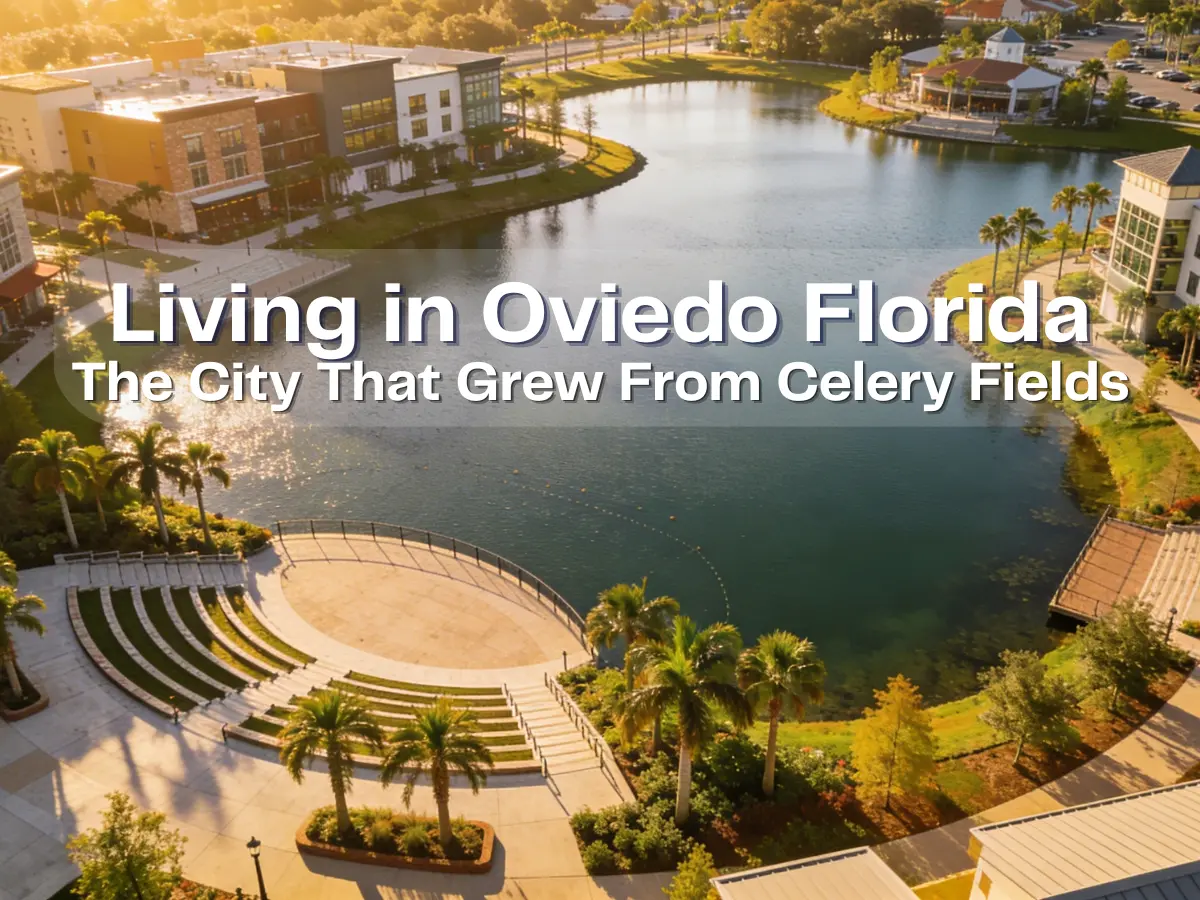
The Oviedo on the Park development, which opened in 2015 around Center Lake Park, added something the city had long lacked: a genuine public gathering place. Restaurants, a craft brewery, an outdoor amphitheater, a dog park, a veterans’ tribute — all centered on a well-designed lakefront. It doesn’t compete with Winter Park’s Park Avenue for polish, but it gives Oviedo a core that feels like a city that has grown into itself.
The honest trade-off is car dependency. Outside of Oviedo on the Park, daily life requires driving. If true walkability is non-negotiable, Oviedo will disappoint. If you want excellent schools, community character, larger lots, and reasonable commute access to major employers — Oviedo consistently delivers.
Schools: Oviedo’s Consistent Selling Point
Seminole County Public Schools rank among Florida’s top-performing districts — a fact that drives sustained buyer demand in Oviedo year after year. Families relocating from outside the region often target Oviedo specifically for the school district. Notable schools include Oviedo High School, Lawton Chiles Middle, and multiple A-rated elementary schools distributed across the city’s neighborhoods.
Private options include St. Luke’s Lutheran School — a direct descendant of the original Slavia community school — and The Master’s Academy. The University of Central Florida is approximately 5 miles from Oviedo’s core, making the city a natural home base for UCF faculty, staff, and nearby Research Park employees.
Oviedo Neighborhoods: Where to Focus Your Search
Oviedo’s residential landscape spans roughly four decades of development, from 1980s ranch-style homes to newer master-planned communities. Here is a practical snapshot of what buyers most commonly explore:
| Neighborhood | Character | Best For |
|---|---|---|
| Live Oak Reserve | Master-planned, pools, parks, A-rated schools | Families, move-up buyers |
| Alafaya Woods | Established, entry-to-mid range, solid appreciation | First-time buyers, investors |
| The Sanctuary | Newer construction, larger homes, modern finishes | Buyers wanting newer builds |
| Twin Rivers | Accessible price points, near UCF corridor | First-time buyers, UCF community |
| Tuscawilla | Golf community, mature trees, mix of home eras | Move-up, golf lifestyle buyers |
| Oviedo on the Park | Urban-lite walkable core, townhomes and condos | Young professionals, downsizers |
| Chuluota / rural east | Large lots, acreage, semi-rural character | Buyers wanting land and privacy |
Browse active listings by neighborhood at orlandonest.com/oviedo-FL/listings.
The Oviedo Real Estate Market in 2026
As of early 2026, the Oviedo market has moderated from the 2021-2023 frenzy into a more balanced pattern. Zillow places the typical home value near $492,000, consistent with Redfin data showing a median sale price around $455,000-$499,000 depending on the data source and month. Homes are spending roughly 60-70 days on market — longer than the peak years, which gives buyers meaningful time to evaluate rather than bidding in 48-hour windows.
The long-term appreciation story remains strong. Over the prior decade, Oviedo real estate appreciated over 130%, placing Oviedo in the top 10% nationally for real estate appreciation according to NeighborhoodScout. Consistent school quality, limited land supply east of UCF, and employer proximity create durable demand underpinning that performance.
For buyers, the current environment offers leverage that didn’t exist two years ago: seller concessions are more common, price reductions are visible on overpriced listings, and inspection negotiations are back. For sellers, correctly priced homes in desirable school zones still find active buyers. Oviedo’s buyer pool is real and motivated — it just no longer accepts overpricing the way it did in 2022.
Explore current market data at orlandonest.com/oviedo-FL/market.
Things to Consider Before Moving to Oviedo
- Car dependency: Outside of Oviedo on the Park, daily life requires driving. Commutes to downtown Orlando typically run 30-45 minutes via SR-417 during peak hours.
- HOA landscape: Most newer master-planned communities carry HOA fees and restrictions. No-HOA homes require deliberate searching — see this guide or orlandonest.com/orlando-no-hoa-homes.
- Flood and insurance awareness: Proximity to Lake Jesup and wetland areas means some properties carry elevated flood insurance costs. Review FEMA flood zone designations as part of due diligence.
- SR-434 and Alafaya Trail traffic: Development pressure has increased congestion on Oviedo’s main corridors. Test your commute at rush hour before committing to a specific neighborhood.
- UCF proximity effect: Neighborhoods closest to UCF see strong rental demand, which can mean investor competition for buyers but solid rental income potential for investors.
Recreation and Community Life
Oviedo’s outdoor options are genuinely strong. The Econ River Wilderness Area offers paddling and hiking trails just minutes from most neighborhoods. The Cross Seminole Trail — which runs through the historic Slavia corridor — connects cyclists and walkers to a broader regional network. Oviedo on the Park’s Center Lake Park hosts the city’s outdoor amphitheater and community events calendar year-round.
Annual events include the Great Day in the Country Arts and Crafts Festival and Oviedo Mardi Gras — community staples that reflect the city’s small-town character. Lukas Nursery’s butterfly conservatory is one of the largest native species facilities in Florida and doubles as a genuinely worthwhile outing on a weekend when you’re not touring homes.
How Oviedo Compares to Nearby Communities
| Area | Price Range | Walkability | Strongest Appeal |
|---|---|---|---|
| Oviedo | $350K-$800K+ | Low-Moderate | Top schools, suburban space, long-term value |
| Winter Springs | $300K-$700K | Low | Similar suburban feel, slightly lower price points |
| Winter Park | $500K-$3M+ | Moderate-High | Historic character, walkability, luxury |
| Baldwin Park | $450K-$1M+ | High | Urban-infill, walkable village center, newer stock |
| Avalon Park | $350K-$700K | Moderate | East Orlando master-planned, family-focused |
For buyers who want the best schools and comfortable suburban space without paying Winter Park prices, Oviedo belongs on the list. For those who need daily walkability, Baldwin Park or Winter Park are stronger fits. The right answer depends on how you actually live day to day.
Explore Oviedo Homes
Browse active Oviedo listings: orlandonest.com/oviedo-FL/listings
Check Oviedo price reductions: orlandonest.com/oviedo-on-sale
New Oviedo listings: orlandonest.com/oviedo-newly-listed
Oviedo market data: orlandonest.com/oviedo-FL/market
Questions about Oviedo? Ted Moseley | Orlando Nest | Real Broker, LLC | (321) 321-2372 | Schedule a call
Is Oviedo a good place to live for families?
Yes — consistently. Seminole County Public Schools rank among Florida’s best, and Oviedo’s neighborhoods offer stable suburban character: safe streets, community parks, reliable commute access to major employers, and more space per dollar than comparably rated school zones in Orange County.
What is the average home price in Oviedo, FL in 2026?
As of early 2026, the median home value in Oviedo is approximately $490,000-$500,000. Prices range from starter homes in the $350,000s to luxury and golf community properties exceeding $800,000, depending on neighborhood, size, and condition.
What is Oviedo, FL known for historically?
Oviedo and the neighboring community of Slavia were once the center of the US celery industry. Slovak immigrant settlers arriving in 1911 — including the Duda family, whose farm grew into the international company A. Duda and Sons — transformed the area into one of the nation’s leading celery producers by the 1920s, earning the region the title ‘Celery Capital of the USA.’
How far is Oviedo from downtown Orlando?
Oviedo is approximately 20-25 miles northeast of downtown Orlando. The SR-417 Greeneway provides direct highway access, with typical peak-hour commutes ranging from 30 to 45 minutes depending on your exact origin and destination.
Are there homes for sale in Oviedo with no HOA?
Yes, though they require deliberate searching. Most newer master-planned communities carry HOA fees. Older neighborhoods like Alafaya Woods and rural or semi-rural properties on Oviedo’s eastern edge often have no HOA or minimal fees. Searching specifically by no-HOA filter produces better results than general portal browsing.
How do Oviedo schools compare to other Central Florida areas?
Seminole County Public Schools consistently rank #1 or #2 among Florida’s 67 school districts. Multiple elementary schools in Oviedo carry A-ratings from the Florida Department of Education. This performance is a primary driver of sustained buyer demand in Oviedo relative to comparable suburban communities in Orange County.
What are the best neighborhoods in Oviedo for families?
Live Oak Reserve and Alafaya Woods are the most frequently recommended for family buyers at different price points. Live Oak Reserve offers master-planned amenities and A-rated schools. Alafaya Woods provides more accessible price points with a well-established community character. Tuscawilla appeals to buyers who want the golf community lifestyle with mature landscaping.
The Bottom Line on Oviedo
Oviedo doesn’t try to be Winter Park, and that’s exactly what makes it work. It’s a city that earned its character the hard way — starting with Slovak immigrants who looked at Central Florida swampland, decided it was a fine place to grow celery, and proceeded to build one of the most quietly remarkable agricultural legacies in Florida history. The Duda family didn’t develop Oviedo on a whiteboard. They farmed it into existence, one acre at a time, and the community that grew up around that effort still has the bones to show for it: good schools, genuine neighborhoods, a downtown that actually means something to the people who live there, and enough trees that you don’t feel like you’re living inside a parking lot.
Is Oviedo perfect? No. You will drive everywhere. Some intersections on SR-434 will test your faith in humanity. But if what you’re looking for is a Central Florida community with top-tier schools, real history, reasonable prices relative to what you get, and neighbors who show up to things — Oviedo tends to make a strong case for itself. It just doesn’t need to yell about it.
f you’re ready to take a real look at what’s available, the listings are there. And if you want someone who knows the difference between a good Oviedo block and a “technically Oviedo” one, that’s what I’m here for.
Related Reading

Oviedo vs. Waterford Lakes: Which East Orlando Community Is Right for You?
If you’re searching for a home in the UCF corridor — east Orlando, Alafaya Trail, somewhere within reach of the Research Park — Oviedo and Waterford Lakes are almost certainly both on your list. They’re close enough geographically that buyers…
Is Oviedo, FL a Good Place to Live? An Honest Local’s Take
When I retired from the Navy and moved to Oviedo around the year 2000, we chose it for the schools. What came with that was something harder to quantify — a neighborhood culture that was difficult to name but easy…

How to Negotiate the Best Price on a Home in Orlando: 2026 Buyer Strategy Guide
This 2026 guide explains how to negotiate a home price in Orlando without overpaying in today’s market. This post covers the full negotiation framework — when buyers have real leverage in Orlando’s 2026 market, and how to structure an offer…
Winter Garden vs. Oviedo: Which Side of Orlando Is Right for Your Family?
Orlando Real Estate • Family Relocation • Community ComparisonThe Fast Answer If your employer or daily commute anchors you to the west side of Orlando — Disney, the tourism corridor, downtown via I-4 — Winter Garden is the stronger fit.…