
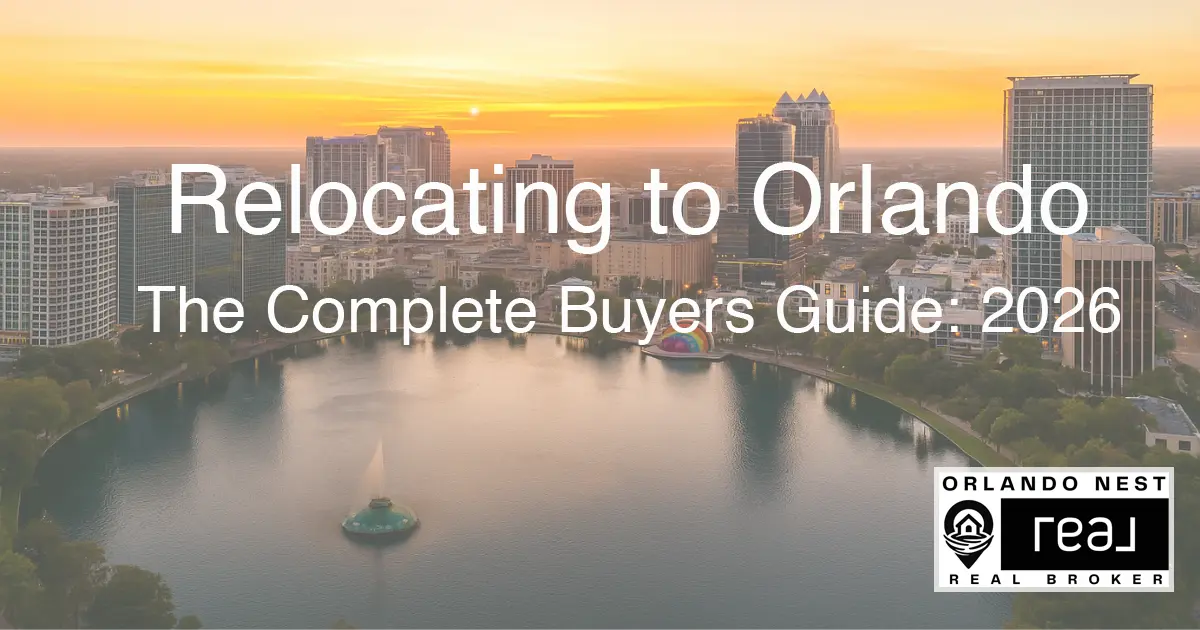
Got that new job that involves relocating to Orlando? Whether you’ve just accepted a job offer or you’re still weighing your options, moving to a new city for a career change is one of the biggest decisions you’ll make. Orlando’s real estate market is set up for exactly this kind of buyer — but navigating it from out of state, under a deadline, takes a different game plan than a local move. This guide covers everything: picking the right neighborhood, timing your purchase around your start date, buying remotely, and understanding what the move actually costs. Relocating to Orlando is absolutely the right move — but it pays to do your homework
1. Why Orlando Makes Sense for Career Movers
Orlando doesn’t get enough credit as a serious career market. Most people picture theme parks — and yes, they’re here — but the metro has quietly become one of the most economically diverse cities in the Sun Belt. Healthcare, aerospace, defense, tech, simulation & modeling, financial services, and a booming logistics sector have all planted deep roots here.
For someone making a career pivot, that diversity matters. You’re not betting on one industry’s health. And with Florida’s no-state-income-tax advantage, your new salary stretches further here than it would in most coastal markets.
Major Employers in the Orlando Metro
- AdventHealth and Orlando Health (healthcare)
- Lockheed Martin, L3Harris, Northrop Grumman, General Dynamics (defense/aerospace)
- Walt Disney World, Universal, Marriott, Rosen (hospitality)
- Deloitte, Raymond James, Advent International (finance)
- UCF, Valencia College, Full Sail University (education)
- Amazon, Chewy, Darden Restaurants (corporate HQs and operations)
The challenge for relocating buyers isn’t finding options — it’s narrowing them down without getting overwhelmed. That’s what this guide is here for.
The most common mistake I see from career-change relocators is fixating on being close to the office. Orlando’s traffic actually rewards strategic positioning — in some cases, living slightly farther from a job corridor but near a commuter route is faster and far more affordable.
— Ted Moseley, REALTOR® · OrlandoNest.com
2. Choosing the Right Neighborhood
Orlando’s market is a collection of distinct communities, each with its own personality, price point, and commute profile. Here’s an honest breakdown of the most popular landing zones for relocating professionals. What follows is just a small subsection of the communities that make up the greater Orlando Metroplex. Each area has its own character.
Orlando Looks Compact on a Map. It Is Not.
Before you fall in love with a neighborhood, test the commute or at the very least consult your REALTOR®. I-4 is one of the most congested corridors in the country — a drive that takes 20 minutes at noon can take 55 minutes at 8am. Winter Park and Lake Nona are both excellent communities. They are also 40 minutes apart on a bad I-4 day, which is most days.
A few rules of thumb before you narrow your list:
- Choose by minutes, not miles — always map your commute with traffic enabled on a Tuesday morning
- The 417, 528, and 429 toll roads move significantly faster than I-4 during peak hours. Budget $80–$150/month if you’re using them regularly
- Hybrid schedules change the math — three days a week in the office opens your viable search radius considerably
- School drop-off adds time — in master-planned communities, 7:45am traffic is its own variable
This is why narrowing your geographic focus before your house hunting trip matters so much — and why we’ll talk through your commute reality before we ever schedule a showing.
Note: I have built custom community pages with the active listings for many of these communities. Clicking on the link will open the listings in a new tab. For all listings in the greater Orlando metropolitan area visit the parent site at OrlandoNest.com
Lake Nona — Medical & Innovation Hub
Home to Orlando’s Medical City campus — UCF College of Medicine, Nemours Children’s Hospital, and the VA Medical Center. Master-planned, walkable, and new-construction heavy. If you’re in healthcare, biotech, or tech, this area is purpose-built for your lifestyle. Median prices range from $420K to $700K+.
Winter Park — Established & Walkable
One of Orlando’s most charming communities. Park Avenue dining and shopping, Rollins College, tree-lined brick streets. Tighter inventory but consistently strong resale value. Budget $500K to $1.5M+ for most homes. A top pick for executives and professionals who want character over new construction.
Baldwin Park — Urban Village Feel, Central Location
Built on the former site of a Naval Training Center, Baldwin Park is one of Orlando’s most thoughtfully designed infill communities — walkable streets, a village center with restaurants and shops, lakes, and trails woven throughout. It sits just minutes from downtown Orlando and Winter Park, making it a strong choice for professionals who want urban connectivity without downtown density. Inventory is tight and turns over slowly because residents tend to stay. When homes do come available, they move quickly. Median prices run $550K–$900K+.
Oviedo / Seminole County — Families & Schools
Consistently top-ranked schools and a strong suburban community feel. Popular with families relocating from the Northeast and Midwest. Good access to the 417 and SR-528 corridors. Median prices run $380K–$550K — one of the better value plays in the metro for what you get.
Dr. Phillips / Bay Hill — Upscale Established
Upscale, mature neighborhood near Restaurant Row and the Dr. Phillips Center for the Performing Arts. Home to Arnold Palmer’s Bay Hill Club. Strong long-term resale history. Expect $500K to $2M+. Popular with executives and professionals who want prestige and proximity to I-4.
Horizon West / Windermere — Growth & Value
One of Florida’s fastest-growing corridors. Newer construction, lower price per square foot than comparable quality elsewhere, and rapidly expanding retail and dining. Disney and UCF Health employees flood this market. A strong long-term appreciation play. Median prices run $380K–$650K.
Sanford / Lake Mary — Commuter Value
An underrated gem with easy access to I-4, SunRail, and the 417. Sanford’s historic downtown is genuinely charming. Lake Mary is polished suburban. Great value for commuters targeting the I-4 corridor. Budget $340K–$520K for most homes.
Celebration — Disney-Developed / Master-Planned Charm
One of the most recognizable planned communities in the country, Celebration was originally developed by Disney and carries that DNA — manicured streetscapes, front-porch architecture, town center dining and retail, and a genuine neighborhood feel that’s rare in new construction. It attracts relocating professionals who want walkability, aesthetics, and a strong sense of community without sacrificing proximity to major employment corridors. Osceola County location means slightly lower property taxes than Orange County. Median prices run $450K–$750K+ depending on home size and proximity to the town center.
Questions to Answer Before Picking a Zip Code
- How far are you actually willing to commute — and is your employer in-office, hybrid, or remote?
- Do you have or plan to have school-age children? (District lines matter enormously in Florida.)
- Do you want walkability, or are you comfortable being car-dependent for amenities?
- New construction or an established neighborhood with character and mature trees?
- HOA or no HOA? Most master-planned communities here have them.
- Are you buying with a long-term horizon, or is this a 3–5 year stop?
Most single-family homes in Orlando’s primary buyer corridors — Orange and Seminole County — are priced above $450,000. The broader MSA median pulls lower due to outlying markets in Osceola and Lake County. Where you will be working, commute, and a large number of other factors will impact what you can expect the median price of a home to be. Always consult a local professional to get a current median for the specific neighborhoods on your list — that’s exactly the conversation I have with every relocation buyer I work with.
3. Timing Your Move Around a New Job
This is where career-change relocators face their biggest stress point: your start date is fixed, your home search is not. Here’s how to think about the timeline honestly.
90+ Days Before Your Start Date
Get pre-approved and start your search — the earlier, the better. Pre-approval isn’t just a formality in Orlando’s market; it’s what separates serious buyers from browsers in the eyes of every listing agent you’ll encounter.
If you’re relocating to Orlando without an established relationship with a local lender, this is one of the most valuable moments to lean on a local REALTOR®. I maintain a network of highly qualified mortgage brokers and lenders who specialize in relocation buyers, new-job offer-letter approvals, and VA financing. These are professionals I’ve referred clients to repeatedly — and who have earned that trust by performing. Getting connected to the right lender early can mean the difference between a smooth close and a last-minute scramble.
Lenders will want to see your employment offer letter as a primary income document — have it ready. From there, begin touring neighborhoods virtually and start narrowing your target areas before you ever book a flight and narrow your target areas.
60–90 Days Out
Active search phase. If you’re relocating to Orlando from out of state, plan at least one focused in-person trip — ideally 2 to 3 days. This is where having the right buyer’s agent makes all the difference. A good agent doesn’t just unlock doors — they sequence your tour strategically, give you honest assessments in real time, and help you move decisively when the right home shows up.
I schedule dedicated relocation tours for out-of-state buyers specifically around this window. We maximize every hour of your visit — neighborhoods in the morning, homes in the afternoon, honest debrief over dinner. It’s completely realistic to go under contract before you’re back at the airport.
One more thing before you book that trip: Orlando is bigger than it looks.
I’ve run house hunting tours that started in Winter Park, moved to Lake Nona, and then got a last-minute “what about Horizon West — it looks close on the map?” request. It is not close. That’s a 45-minute drive on a good day, longer if I-4 has other plans — and I-4 usually has other plans.
Before your trip, commit to a geographic focus. Pick one or two corridors based on your commute, your must-haves, and your budget. That highly focused 2–3 day tour we plan of the right areas will always outperform a scattered tour of the whole metro. Your time on the ground is finite — use it to go deep on the right neighborhoods, not wide across all of them.
This is exactly the conversation I have with every relocation buyer before we schedule a single showing. Let’s have it before you book your flights. →
30–60 Days Out
Under contract and moving through the closing process — this is where the Orlando home buying process runs largely on autopilot for you. Standard Florida closings take 30–45 days, and one of the genuine advantages of working with an experienced local agent is that the logistics keep moving even while you’re still in your home state wrapping up your old life.
Your agent coordinates with the title company, tracks inspection deadlines, manages the appraisal timeline, and keeps your lender on schedule. For buyers relocating to Orlando for a job, this phase often overlaps with giving notice, managing a move, and navigating a new employer’s onboarding — the last thing you need is to also be chasing paperwork from two states away.
Florida also allows fully remote closings via Remote Online Notarization, so you won’t need to fly back to sign documents. When we get to this phase together, your job is to focus on your move. Mine is to make sure nothing falls through the cracks on the real estate side.
When Your Start Date Arrives
Ideally you’ve closed before Day 1. If the timeline is tight, short-term rentals — furnished apartments, extended-stay hotels, and Airbnb — are widely available in Orlando. Don’t force a bad home decision because of deadline pressure. A 3-month rental that buys you clarity is far cheaper than buying in the wrong neighborhood.
Most lenders will approve you on a new job offer letter if you’re staying in the same field. Changing industries or going from W-2 to self-employed is harder — this is a conversation to have at the very start of your search, not the week before closing.
— Ted Moseley
4. The Home Buying Process in Florida
Florida runs on its own rulebook. The closing process, the inspection period, the insurance market — none of it works quite the way buyers from other states expect. Knowing these quirks before you make an offer isn’t just helpful. It can save you thousands.
Florida Uses Title Companies, Not Attorneys
Unlike some states where a real estate attorney is legally required at closing, Florida uses title companies to handle the entire transaction. They manage the transfer of funds, search for liens, and issue title insurance. You don’t need an attorney — but you can hire one if it gives you peace of mind.
The Inspection (Due Diligence) Period
Florida contracts include an inspection period — typically 10 to 15 days — during which you can back out for any reason and receive your deposit back in full. Use every day of it. At the bare minimum, get a general home inspection, a 4-point inspection (roof, HVAC, plumbing, electrical), and a wind mitigation inspection. The wind mit report can meaningfully lower your insurance premiums.
A few things that catch out-of-state buyers off guard: many older and unincorporated areas of Orlando are not connected to public sewer — they run on septic systems. Some larger properties outside city limits have private wells for drinking water too. Neither of these is a red flag. Septic systems and wells are common, often well-maintained, and can actually reduce your monthly utility costs. But you need to know to ask the question before you’re under contract — not after.
Roof age is another one. In Florida, roof condition isn’t just a maintenance issue — it directly affects your ability to get insured and what you’ll pay for coverage. We’ll cover that in detail in the insurance section below, but it starts here: always find out the roof age before you fall in love with a house.
Florida Homeowners Insurance: The Big Surprise
This is the number one shock for out-of-state buyers. Florida’s insurance market has tightened significantly — several major carriers have left the state entirely, and premiums are well above national averages. That said, recent reforms in the state legislature are beginning to stabilize the market, and more carrier options are slowly returning. It’s still a factor you need to plan for, but the trajectory is improving.
Two factors drive your rate more than anything else: the age of the roof and the year the home was built. A roof over 15 years old can make a property difficult — sometimes impossible — to insure with standard carriers. Homes built before 2000 were constructed to older wind codes and carry higher risk in the eyes of insurers. On newer construction in Orange or Seminole County you can still find reasonable rates. On older homes or properties in higher wind-exposure areas, costs can be substantial — and occasionally a deal-changer.
The wind mitigation report you order during inspection isn’t just a formality. If the home has hurricane straps, impact-resistant windows, or a hip roof, that report can unlock meaningful discounts. It pays for itself.
Always get an insurance quote before you make an offer — not after you’re under contract. I connect my relocation clients with local independent insurance brokers early in the search process for exactly this reason. Knowing your insurance cost upfront is part of knowing your true monthly payment.
What Closing Costs Look Like in Florida
Budget 2–3% of the purchase price for buyer closing costs. This includes title insurance, documentary stamp taxes, lender fees, and prepaid escrow items (homeowner’s insurance, property taxes). In some transactions sellers will contribute to closing costs — your agent can negotiate this.
| Cost Item | Typical Range | Notes |
|---|---|---|
| Lender / Origination Fees | 0.5–1% of loan | Shop multiple lenders |
| Title Insurance (Owner’s Policy) | $1,000–$3,500+ | Based on purchase price |
| Home Inspection | $350–$600 | Plus specialty inspections |
| Appraisal | $500–$750 | Lender-ordered; paid upfront |
| Prepaids / Escrow Setup | $3,000–$6,000 | Insurance and tax reserves |
| Documentary Stamps (Mortgage) | 0.35% of loan | Florida-specific tax |
Why Local Expertise Matters Here
Every one of these line items has nuance that an out-of-state agent — or a local agent who doesn’t work relocations regularly — can miss. I’ve walked buyers through Florida closings who were blindsided by their insurance quote, who didn’t know to order a wind mit report, or who didn’t realize they could have negotiated seller concessions on closing costs. My job isn’t just to find you a house. It’s to make sure none of Florida’s quirks catch you off guard the way they do buyers who come in unprepared.
5. How to Buy a Home Remotely
Out-of-state buyers close on Orlando homes every week without ever setting foot inside before closing. With the right agent and the right approach, it works reliably. Here’s how it actually happens.
Video Tours That Show You What Actually Matters
Any agent can FaceTime you through a listing. A great agent will walk you through the street, show you the neighborhood at different times of day, point out proximity to what you care about, and be honest about what the listing photos are hiding — the busy road behind the yard, the neighbor’s fence, the low ceilings. Ask for a tour that starts outside, not in the kitchen.
The One In-Person Trip
As we covered in the timing section, one focused 2–3 day visit — properly sequenced and prepared — is all most relocation buyers need. You’re not coming to explore. You’re coming to decide.
The Biggest Risk in Remote Buying
It’s not the transaction — it’s buying in the wrong neighborhood. Spend serious time with Google Street View, neighborhood Facebook groups, Nextdoor, and YouTube drive-through videos before you commit to an area. And use an agent who actually lives and works in the specific communities you’re targeting, not someone covering the entire metro.
I’ve worked with relocation buyers who did everything right — got pre-approved early, flew in for a focused tour, moved decisively — and still almost landed in the wrong zip code because their agent didn’t know the difference between two subdivisions that look identical on Zillow but feel completely different on the ground. That local knowledge isn’t a bonus. It’s the whole job.
If you’re buying remotely, let’s talk before you start shortlisting neighborhoods. A 30-minute conversation upfront can save you weeks of searching in the wrong direction. Book a call here →
6. The True Cost of Relocating to Orlando
The sticker price on a home is one number. Here’s the full picture of what moving to Orlando actually costs — and where Florida gives you real financial advantages.
Sample Monthly Housing Cost at $450,000
Assuming 10% down and a 5.75% interest rate:
One-Time Relocation Expenses to Budget For
- Moving company or POD rental: $2,500–$8,000+ depending on distance and volume
- House-hunting trip flights and lodging: $500–$1,500
- Temporary housing if needed: $1,500–$4,000/month
- Florida driver’s license and vehicle registration: ~$200–$400
- New furniture or items not worth shipping: varies
- Home warranty on an older home: ~$500–$700/year
Florida’s Financial Advantages for New Residents
Florida has no state income tax. A $100,000 salary here is effectively $5,000–$10,000 more in take-home pay than the same salary in many other states.
Once you establish primary residency, Florida’s Homestead Exemption reduces your assessed property value by up to $50,000 — lowering your annual tax bill meaningfully.
For veterans with a 100% disability rating, Florida offers a full property tax exemption. In most cases this eliminates the ad valorem portion of your tax bill entirely. There may be small residual non-ad valorem assessments — things like fire and emergency services, or CDD (Community Development District) fees in newer planned communities — but even with those, the savings are substantial month to month.
7. VA Loans and Military Relocation Buyers
Orlando has a significant veteran and active-duty military community, with Patrick Space Force Base, NAS Jacksonville within range, and a dense cluster of defense contractors along the I-4 corridor. The region is also home to one of the country’s newest VA medical facilities, located in Lake Nona’s Medical City — a major draw for honorably discharged veterans with a disability rating who want reliable, modern access to VA healthcare close to home. If you’ve earned your VA loan benefit, Orlando is one of the best places in the country to use it.
Why VA Loans Work Well in Orlando
No down payment, no PMI, and competitive rates. In a market where 20% down on a $450,000 home means $90,000 out of pocket, the VA benefit is genuinely life-changing. Florida sellers are familiar and comfortable with VA offers, which eliminates friction that VA buyers often face in other states.
VA-Specific Considerations in Florida
VA appraisals run conservative, and some sellers — or their agents — get nervous about VA offers as a result. It’s a legitimate consideration, not a myth. But it’s also a solvable one. I’ve navigated VA appraisal gaps more than once, and when both sides understand what’s actually at stake, you can almost always find a path that works for everyone. A VA offer with an experienced agent behind it is a strong offer.
- VA loans have Minimum Property Requirements — some older or fixer-upper homes won’t qualify
- Florida’s Homestead Exemption has additional provisions for disabled veterans, up to full exemption at 100% disability rating — and as covered in the finance section, there may be small residual non-ad valorem assessments but the savings are still substantial
As a fellow veteran, this is personal to me. I work with military families specifically because I understand the unique stressors of relocation under time pressure. If you’re a vet or active duty, let’s talk — you’ll get a straight answer, not a sales pitch.
— Ted Moseley, Navy Veteran & REALTOR®
8. Frequently Asked Questions
Can I get a mortgage with a job offer letter and no pay stubs yet?
In most cases, yes. If you’re staying in the same field and moving to a W-2 salary position, most lenders will approve you using your offer letter as income documentation. Changing industries significantly, moving to self-employment, or going contract-only makes it more complex. Lenders need a non-contingent offer letter with a clear start date and stated salary. This is always worth a conversation with your lender before you start touring homes.
How long does it actually take to buy a home in Florida?
From accepted offer to closing, budget 30–45 days. The search phase varies — some buyers find their home in a week, others take two months. Total time from “I need to move” to keys in hand is typically 60–90 days if you’re organized and pre-approved from the start.
Should I rent first to get the lay of the land, or buy right away?
Honestly, both approaches can be right. Renting first gives you time to discover which area actually fits your life before you commit. Buying immediately avoids double-moving costs and captures the market. The key variable is how confident you are about the neighborhood. If you’ve done serious research and have a strong preference, buy. If you’re torn between multiple areas, a 6-month rental buys you clarity that’s worth far more than the moving hassle.
What’s the deal with Florida homeowners insurance?
It’s the conversation nobody wants to have but everybody needs to. Florida’s insurance market has tightened significantly — several major carriers have left the state entirely, and premiums are well above national averages. That said, recent legislative reforms are beginning to stabilize the market and more carriers are slowly returning, so the trajectory is improving.
Two factors matter most: roof age and the year the home was built. A roof over 15 years old can make a property difficult to insure with standard carriers. Older homes built before 2000 carry higher risk in the eyes of insurers. On newer construction in Orange or Seminole County you can still find manageable rates.
Always get an insurance quote before you make an offer — not after you’re under contract. It should be part of your research from the start, not a surprise at the closing table.
Do I need a buyer’s agent, or can I just go direct to listing agents?
You can go direct — but it rarely benefits you. A listing agent represents the seller. Going directly to them doesn’t typically save you money, and you lose dedicated representation at every step. A buyer’s agent’s job is to help you win the right home at the right terms and protect you through the process. As a relocating buyer operating remotely under a deadline, that representation is more valuable, not less.
Can I use my VA loan benefit when relocating to Orlando for a civilian job?
Absolutely. Your VA loan entitlement isn’t tied to active duty status — it’s earned, and you can use it whether you’re separating from service or have been out for years. No down payment, no PMI, and competitive rates make it one of the most powerful buying tools in any market. Orlando sellers are generally comfortable with VA offers, and with the right agent behind it a VA offer is a strong offer.
Does Florida offer property tax benefits for disabled veterans?
Yes — and they’re among the best in the country. Benefits are tied to your VA disability rating and start at 10%:
At 10% or more service-connected disability you’re eligible for a $5,000 reduction in your property’s assessed value. Veterans 65 or older with a permanent combat-related disability may receive a discount equal to their disability percentage. At 100% permanent and total disability, you’re fully exempt from ad valorem property taxes on your homesteaded property — a savings that can run several thousand dollars a year. Surviving spouses of qualifying veterans may retain the full exemption as well.
You’ll need proof of honorable discharge, a VA-certified disability letter, Florida residency, and an application filed with your county property appraiser by March 1st of the tax year.
Ready to Make Your Move?
I work specifically with relocating buyers — remote video tours, offer-letter mortgage guidance, honest neighborhood-by-neighborhood advice, and zero pressure. Let’s talk through your timeline before you start clicking listings.
Selections open in a new tab