
Selling a home as Tenants in Common happens more than people realize. Two people buy a home together, both names on the title, possibly both on the mortgage because that’s what the lender needed. Then the relationship changes. Now the house — the asset that made complete sense when things were good — needs to move, and the process of doing that depends entirely on how the two of you are doing right now.
Some days are easy. Some days are not. Most situations land somewhere in between, and they can shift.
This is a guide for co-owners navigating a home sale in Florida when there’s no marriage, no divorce court, and no automatic legal framework to lean on. What you have instead is a title, a shared financial interest, and whatever goodwill exists between you on any given day.
What “Tenants in Common” Actually Means
When two unmarried people buy a home together in Florida, they typically take title as tenants in common. This is different from how married couples usually hold title — married couples typically hold property as tenants by the entirety, which has survivorship rights and some legal protections built in.
As tenants in common, each party owns a defined share of the property — often 50/50, though not always. That share is yours individually. You can theoretically sell your share, will it to someone, or borrow against it. What you cannot do unilaterally is sell the whole property. That requires both owners.
| Florida title noteUnder Florida Statute 689.15, a conveyance to two or more people does NOT automatically create a right of survivorship unless that language is explicit in the deed. Most unmarried co-buyers end up as tenants in common by default. If you’re unsure how your deed reads, a title company or real estate attorney can confirm it quickly. |
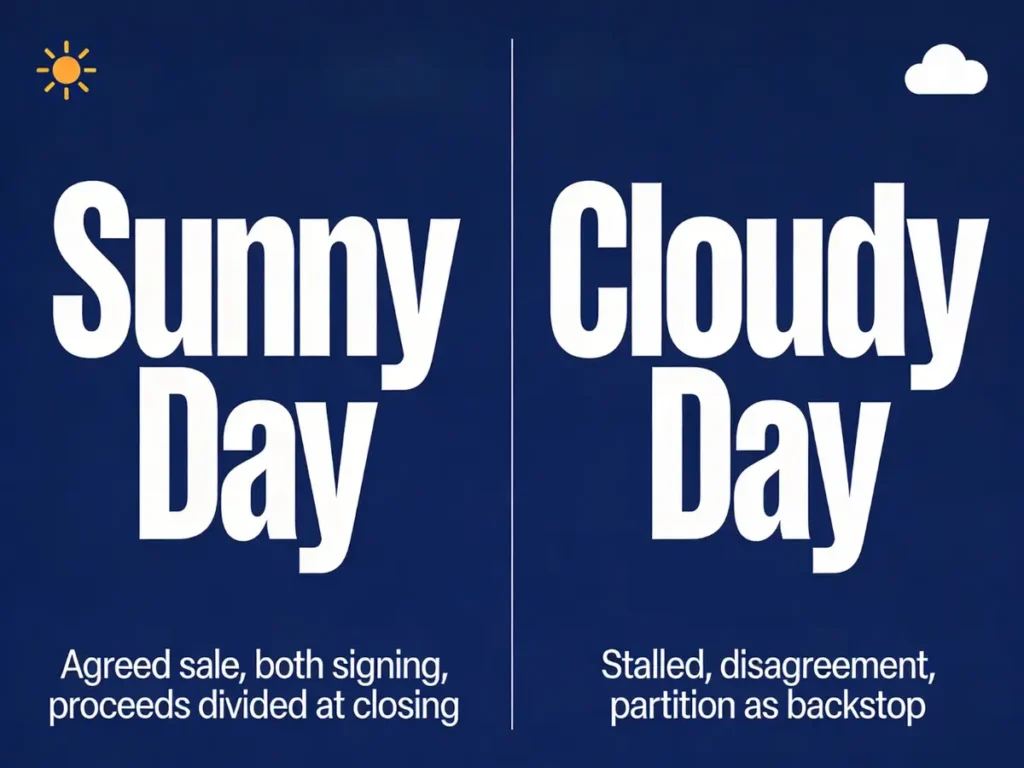
The Sunny Day Version
The best-case scenario: both of you agree it’s time to sell, you agree on roughly what the home is worth, and you’re both willing to sign what needs to be signed. The relationship may be over, but the transaction doesn’t have to be painful.
In this version, the process looks almost identical to any other home sale. We price using current market data, prepare the home for photos and showings, launch to market, evaluate offers together, and close. The main practical differences are:
- Both owners must sign the listing agreement
- Both owners must sign the purchase contract and any addenda
- Proceeds are divided at closing per the ownership shares on the deed — the title company handles the math
- Both owners need to provide closing instructions for where their respective proceeds are wired
The key to keeping the sunny day sunny is establishing simple written agreements upfront — who approves a list price, what the floor is for accepting an offer, how repairs and credits are handled — before any of those decisions need to be made under pressure. Small frictions become large ones when they’re improvised mid-transaction.
The Cloudy Day Version
The harder version: one party wants to sell and the other is dragging their feet, disagrees on price, or simply isn’t responding. This is more common than either party expects when they buy together, and it’s worth understanding your options before you need them.
Option 1: Keep Talking
Most stalled co-owner sales resolve through conversation, not litigation. Sometimes one party doesn’t feel heard on pricing. Sometimes the timeline feels rushed. Sometimes there’s a lease or living situation complicating things. A neutral third party — whether that’s an agent, a mediator, or a mutual friend both parties trust — can often move things forward when direct communication has stopped working.
A frank conversation about what a partition action actually involves — cost, timeline, court involvement, loss of control over the outcome — is sometimes the most effective way to get both parties back to the table voluntarily.
Option 2: One Party Buys Out the Other
If one co-owner wants to keep the home and can qualify for financing on their own, a buyout is often the cleanest path. This involves a new appraisal to establish value, a refinance to remove the departing co-owner from the mortgage, and a deed transfer. It requires the remaining party to qualify independently — at current interest rates and based on their income alone — which isn’t always possible but is worth exploring before assuming a sale is the only option.
Option 3: Partition Action
When agreement isn’t reachable, Florida law provides a legal remedy: a partition action under Florida Statute Chapter 64. Either co-owner can petition the court to force the sale of the property. The court will typically order the home sold and the proceeds divided according to ownership shares.
A partition action is a legitimate legal tool, but it comes with real costs: attorney fees, court timelines, and a process neither party controls. In most cases, it’s a last resort — and the realistic prospect of it is often enough to motivate a voluntary agreement.
| The practical reality of partition | Most attorneys who file partition actions in Florida will tell you the same thing: the process usually settles before it reaches a court-ordered sale. The filing itself changes the dynamic. If you’re at an impasse, consulting a real estate attorney about your options — not necessarily to file, but to understand your leverage — can help move things forward. |
The Loan Complication
One detail that complicates many co-owner sales: both parties are often on the mortgage, not just the deed. This matters because even if you resolve the title question, the lender’s interest has to be satisfied at closing. The mortgage gets paid off from proceeds regardless of any private agreement between co-owners. Neither party can simply walk away from the loan without the other’s cooperation — both signatures are typically required to close.
If one party is current on payments and the other has stopped contributing, that creates both a financial and a negotiating dynamic worth addressing early. Late or missed payments hurt both parties’ credit, regardless of who stopped paying.
What the Sale Process Actually Looks Like
Whether the day is sunny or cloudy, the real estate mechanics are the same once both parties are aligned. We establish decision authority in writing before listing, price using current Central Florida market data rather than what either party needs the number to be, prepare the home for photos and launch to market, and manage showings and offer review with both parties copied on everything.
For a full breakdown of what sellers pay at the closing table in Florida — commissions, title, taxes, and prorations — see What Are Closing Costs for Sellers in Florida. For a deeper look at pricing strategy in the current Orlando market, our home pricing guide covers the key factors.
If your situation also involves a formal divorce proceeding, the divorce home sale guide covers the additional legal considerations that apply when a court is involved.
If you’re navigating a co-owner sale in Central Florida and want to talk through where things stand — without pressure and without taking sides — a free home evaluation is a good starting point. You can also schedule a private conversation here.
Can one co-owner force the sale of a jointly owned home in Florida?
Yes. Under Florida Statute Chapter 64, either co-owner can file a partition action in circuit court to compel the sale of the property. The court will typically order the home sold and proceeds divided according to ownership shares. That said, most partition disputes settle before reaching a court-ordered sale — the filing itself often motivates the other party to negotiate. A partition action is a legal remedy of last resort, not a first step.
What is the difference between tenants in common and joint tenants with right of survivorship?
Tenants in common means each owner holds a defined, separate share of the property that can be sold, willed, or borrowed against independently. There is no automatic survivorship — if one owner dies, their share passes through their estate, not automatically to the other owner. Joint tenancy with right of survivorship means that if one owner dies, their share transfers automatically to the surviving owner. In Florida, this survivorship language must be explicit in the deed — without it, co-owners default to tenants in common.
Do both co-owners have to agree to sell the home?
In practice, yes. While either party can file a partition action to force a sale through the courts, a voluntary sale requires both owners to sign the listing agreement and the purchase contract. A buyer’s lender and title company will not close without all owners’ signatures. If one party refuses to cooperate, the options are negotiation, mediation, a buyout, or ultimately a partition action.
How are sale proceeds divided between co-owners at closing?
Proceeds are typically divided according to the ownership percentages on the deed — often 50/50 for co-buyers, but not always. The title company handles the division at closing. If one party contributed more to the down payment or has been making a larger share of mortgage payments, those arrangements are generally a private matter between the parties and are not automatically reflected in the closing distribution unless documented through a separate written agreement or court order. This is worth clarifying before the sale, not at the closing table.
What happens to the mortgage when co-owners sell?
The mortgage is paid off in full from the sale proceeds at closing, regardless of any private arrangement between co-owners. The lender’s payoff comes first, then any remaining proceeds are distributed to the owners. Both parties are legally obligated on the loan until it is paid off or refinanced — one party cannot simply remove themselves from the mortgage without either selling the property or refinancing into a new loan in their name alone.
Can an unmarried co-owner be bought out without selling the home?
Yes. If one co-owner wants to keep the property, they can buy out the other’s share — typically through a refinance that pays off the existing mortgage and provides cash to the departing co-owner equal to their equity share. This requires the remaining party to qualify for the new loan independently, which depends on their income, credit, and the current interest rate environment. A new appraisal is typically required to establish the value and calculate the buyout amount. It’s worth running the numbers before assuming a sale is the only option.
Are there tax implications when selling a jointly owned home in Florida?
Florida has no state income tax, but federal capital gains rules apply. For a primary residence, the IRS allows each individual owner to exclude up to $250,000 in gains — so two co-owners could potentially exclude up to $500,000 combined, provided each meets the ownership and use tests (owned for at least two years and lived in the home as a primary residence for at least two of the last five years). The rules can be more nuanced when one party moved out before the sale. IRS Publication 523 covers the details. Consult your CPA before closing. This response should not be considered legal or financial advise and is subject to change.
Ted’s Take
The co-owner situations I remember most aren’t the ones where everything went sideways — they’re the ones where one conversation changed the whole trajectory. Two people who bought a home together when life looked one way, now trying to figure out how to separate something they built together. The cloudy days are real. But so are the sunny ones. My job is to show up neutral, lay out the options clearly, and make the process straightforward enough that neither party feels like they’re losing more than they already are. Most of the time, that’s enough to get it done.
Ted Moseley is a Central Florida REALTOR® with Orlando Nest – Real Broker, LLC, helping buyers and sellers make clear, data-driven decisions across Orlando, Winter Park, Lake Nona, College Park, and surrounding neighborhoods.
Explore: Market Update · Home Value · Sell a Home · Reviews · More Articles
Have a question about timing, pricing, or next steps? Schedule a quick 30-minute call →
© Ted Moseley – Orlando Nest – Real Broker, LLC