
A 2026 Guide for Orlando Home Sellers
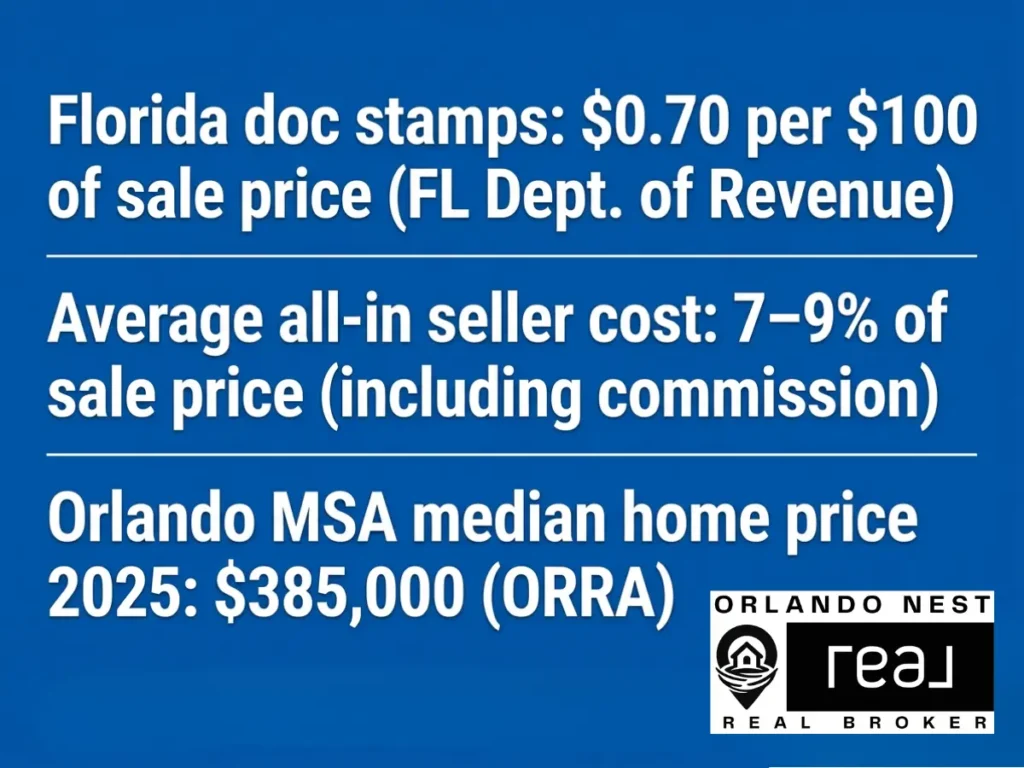
Closing costs for sellers in Florida are one of the most misunderstood parts of selling a home. Sellers often focus on the list price and the commission, then find themselves surprised by what else comes off the top at the closing table. In Central Florida’s current market, with the median home price sitting at $385,000 according to the Orlando Regional REALTOR® Association’s full-year 2025 data, those closing costs for sellers in Florida add up quickly.
This guide breaks down exactly what Orlando sellers pay to close, what’s negotiable, and where the real opportunities to protect your net proceeds are.
This guide outlines the closing costs for sellers in Florida, breaking down exactly what Orlando sellers pay to close, what’s negotiable, and where the real opportunities to protect your net proceeds are.
Understanding these closing costs is essential for a smooth transaction. Excluding real estate commissions, Florida sellers typically pay between 2.5% and 3.5% of the sale price in closing costs for sellers in Florida.
For instance, when calculating your net proceeds, consider the closing costs for sellers in Florida. On a $385,000 sale, that’s roughly $27,000 to $35,000 coming off your gross proceeds before you see a check.
The Short Answer: What Do Sellers Pay in Florida?
Excluding real estate commissions, Florida sellers typically pay between 2.5% and 3.5% of the sale price in closing costs. Add a standard commission structure, and your all-in cost of selling usually lands between 7% and 9% of the final sale price.
On a $385,000 sale, that’s roughly $27,000 to $35,000 coming off your gross proceeds before you see a check. Understanding each piece helps you plan—and helps you identify where negotiation is actually possible.
| 2026 Market Context |
| Orlando MSA median home price (full-year 2025): $385,000 (all-time high, per ORRA) |
| Median listing price, Orlando-Kissimmee-Sanford MSA (Feb 2026): $415,000 (Realtor.com via FRED) |
| Average days on market: 72 (as of late 2025, ORRA) |
| Average commission rate in Florida (2026): approx. 5.5%–5.6% of sale price |
| These numbers set the baseline for calculating what your net proceeds are likely to look like. |
Line-by-Line: What Sellers Pay at Closing in Florida
1. Documentary Stamp Tax (“Doc Stamps”)
This is Florida’s transfer tax on the deed, and it’s non-negotiable. The Florida Department of Revenue sets the rate at $0.70 per $100 of the sale price in most counties, including Orange and Seminole. Miami-Dade is the notable exception with an additional county surtax.
On a $385,000 sale, doc stamps total $2,695. It’s one of the larger fixed costs you’ll see, and unlike some items, you cannot shop it away.
2. Owner’s Title Insurance
In most Florida counties, including the Orlando market, it’s customary for the seller to pay for the buyer’s owner’s title insurance policy. This is one of the costs that surprises sellers from out of state, where buyer responsibility is more common.
Florida title insurance rates are promulgated by the state, meaning the rate structure is fixed—but who pays is negotiable. The cost runs approximately $5.75 per $1,000 of value for the first $100,000, and $5.00 per $1,000 thereafter. On a $385,000 sale, you’re looking at roughly $1,998 for the owner’s policy.
If market conditions favor buyers—which they increasingly do in parts of Orlando where inventory has grown—shifting the title insurance cost to the buyer is a negotiating tool worth knowing about.
3. Title Services and Settlement Fee
Beyond the insurance premium itself, the title company charges a settlement or closing fee that covers the actual work of running the closing: conducting the title search, preparing the deed and all closing documents, and coordinating with all parties. Expect to pay around $1,200–$1,500 for this service in the Orlando market.
4. Prorated Property Taxes
Florida property taxes are paid in arrears, which means at closing you’ll owe a prorated share of the current year’s taxes up through your closing date. The amount depends on when in the year you close and your property’s assessed value.
For example, if you close on June 1 and your annual property tax bill is $4,800, you’ll credit the buyer approximately $2,197 (roughly 5 months of the year at a daily rate). This isn’t money you lose per se—it’s money that would have been yours to pay anyway, just settled at the table.
5. HOA Estoppel Fee
If your home is in a Homeowners Association—which describes a significant share of Central Florida properties, particularly in communities like Baldwin Park, Lake Nona, Dr. Phillips, and Winter Park—you’ll pay for an estoppel letter before closing.
This document, issued by the HOA, confirms that your dues are current and there are no outstanding violations or assessments. Florida statutes cap what associations can charge for this, typically around $299 for standard turnaround and an additional rush fee if needed quickly.
6. Recording Fees
The county charges a modest fee to record the deed transfer. In Orange and Seminole counties, expect to pay approximately $70–$100. Small, but worth knowing it’s there.
Here’s a summary of typical seller closing costs in the Orlando market for a $385,000 sale:
Closing Costs for Sellers in Florida Summary
|
Cost Item
|
Typical amount
|
Time Slots
|
|---|---|---|
|
Documentary Stamp Tax |
$2,695 |
Fixed. Set by FL Dept. of Revenue at $0.70/$100 |
|
Owner’s Title Insurance |
~$1,998 |
Customarily seller-paid in Orange/Seminole Co. |
|
Title Services / Settlement Fee |
$1,200–$1,500 |
Covers title search, document prep, closing mgmt |
|
Prorated Property Taxes |
Varies |
Depends on closing date and assessed value |
|
HOA Estoppel Fee |
~$299+ |
Required for HOA properties (very common in Orlando) |
|
Recording Fees |
$70–$100 |
County-level charge; small but fixed |
|
Real Estate Commission |
~5.5% (approx. $21,175) |
Negotiable; covers listing agent and buyer’s agent |
|
Total (excl. commission) |
~$6,200–$6,600 |
Before commission; roughly 1.6%–1.7% of sale price |
|
Total (incl. commission) |
~$27,000–$28,000+ |
Approx. 7%–9% of sale price all-in |
What’s Actually Negotiable—and What Isn’t
Documentary stamp tax is non-negotiable. The state sets the rate, and the title company collects it at closing without exception.
Closing Costs for Sellers in Florida Summary
Commission is the most negotiable line item and the one with the most leverage. Post-NAR settlement practices (effective since 2024) mean buyer agent compensation is no longer advertised on the MLS, though sellers can and often do offer it as a seller concession to attract more buyers. The listing side of commission is fully negotiable with your agent.
Title insurance is interesting: the rate schedule is state-set, but who pays is negotiable. In a balanced or buyer-favoring market, you may be able to negotiate title insurance responsibility to the buyer. In a competitive seller’s market, that leverage diminishes.
HOA estoppel fees and recording fees are effectively fixed—they’re small enough that the negotiating energy isn’t usually worth it.
How Orlando’s Neighborhoods Affect Your Net Proceeds
The neighborhood where your home sits affects closing costs in ways that go beyond price. Properties in HOA-governed communities—which covers most of Baldwin Park, Dr. Phillips, Lake Nona, and Winter Park’s planned communities—carry estoppel costs and prorated HOA dues that properties without HOAs do not.
Higher-priced homes also generate higher doc stamp bills and larger title insurance premiums by definition, since both scale with the sale price. A $650,000 home in Dr. Phillips carries a doc stamp obligation of $4,550 versus $2,695 on a $385,000 home.
Understanding your specific community’s HOA requirements and your county’s current assessment rates before you list is part of building an accurate net sheet—the calculation that shows your true take-home after everything is paid.
Timing Your Sale and Its Impact on Costs
Closing date timing affects your prorated property tax credit in a straightforward way: the later in the year you close, the larger the credit you provide the buyer. Conversely, closing early in the year means a smaller proration.
It also affects HOA prorations if you’ve prepaid dues for a quarter or year. If you close before the period ends, the buyer credits you back for the unused portion.
From a market dynamics standpoint, Orlando’s spring and early summer selling season historically produces stronger buyer competition, which can translate to a higher sale price—and a higher gross number means your fixed costs represent a smaller percentage of the total. Seller strategy and market timing both feed into what actually ends up in your pocket.
For more on how to get the most out of your pricing strategy, see Orlando Home Pricing Strategy and Why Days on Market Tells a Better Story Than List Price.
Building Your Net Sheet Before You List
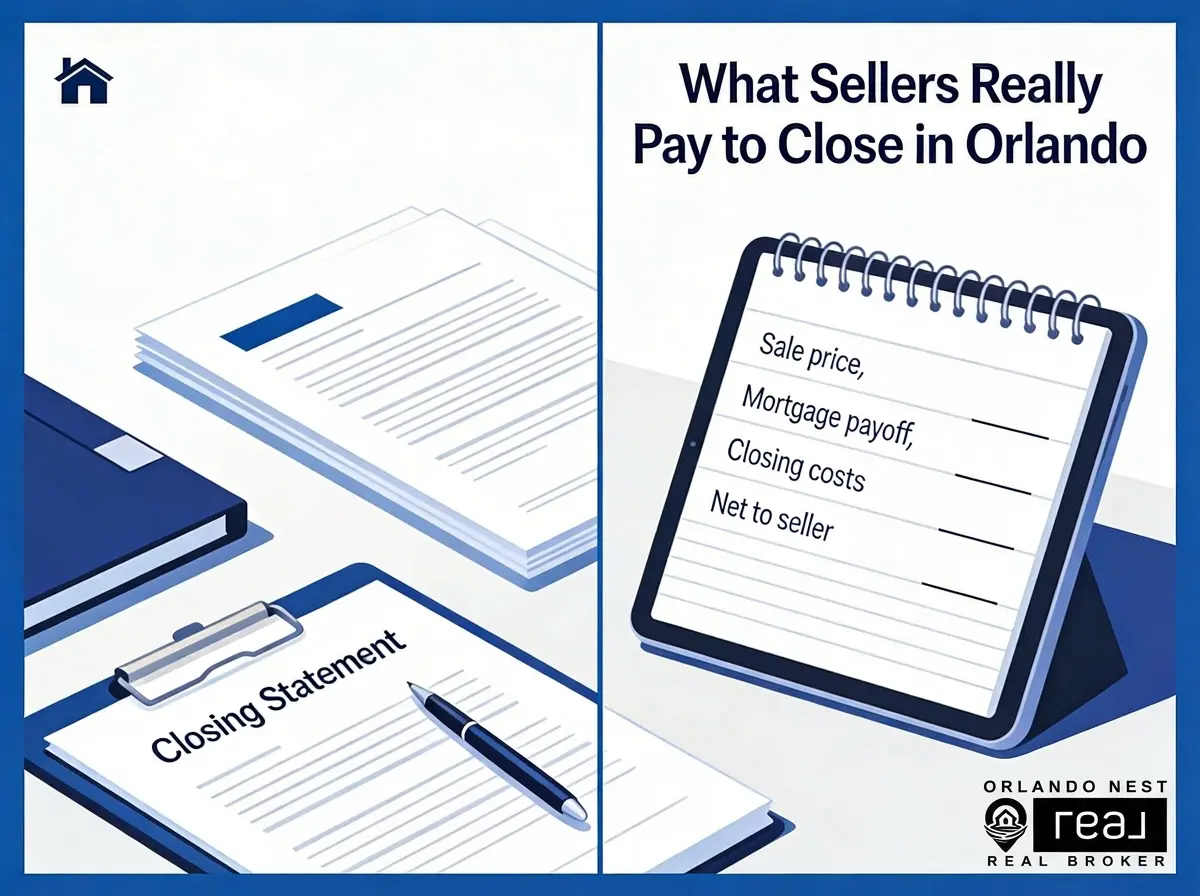
A net sheet is exactly what it sounds like: a line-by-line projection of every cost coming off your gross sale price so you know what you’re actually taking home. Smart sellers ask for this before they sign a listing agreement, not after they accept an offer.
It should include:
- Your outstanding mortgage payoff (if applicable)
- Estimated closing costs based on your target sale price
- Commission structure
- Any agreed-upon seller concessions
- Prorated taxes and HOA dues
- Any pre-listing costs (repairs, staging, pre-inspection)
I run net sheets for every seller I work with in the OrlandoNest market area—it’s one of the first conversations we have. If you’d like a current picture of your home’s value and a realistic net projection, you can request a free home evaluation here. Or, if you’d prefer to talk through the numbers directly, schedule a no-obligation conversation here.
What are typical closing costs for sellers in Florida?
Florida sellers typically pay between 2.5% and 3.5% of the sale price in closing costs, not counting real estate commissions. The main items are the documentary stamp tax ($0.70 per $100 of sale price), owner’s title insurance (customarily seller-paid in most Florida counties), title services and settlement fees, prorated property taxes, and—for HOA properties—an estoppel fee. Add a standard commission structure of roughly 5.5% and your total cost of selling in Florida generally runs between 7% and 9% of the final sale price.
Who pays the documentary stamp tax in Florida—buyer or seller?
The documentary stamp tax on the deed is almost always paid by the seller in Florida. It’s a state-mandated transfer tax set at $0.70 per $100 of the sale price in most Florida counties, including Orange and Seminole. There is no way to waive or avoid this cost—it is collected by the title company and remitted to the state at closing. On a $385,000 sale, the doc stamps total $2,695.
Does the seller pay for title insurance in Florida?
In most Florida counties, including the Orlando market (Orange and Seminole counties), it is customary for the seller to pay for the buyer’s owner’s title insurance policy. This often surprises sellers who relocated from states where title insurance is a buyer expense. While the rate schedule is regulated by the state of Florida, who pays title insurance is negotiable between buyer and seller. In market conditions that favor buyers, sellers sometimes successfully shift this cost to the buyer as part of offer negotiations.
What is an HOA estoppel fee, and do I have to pay it?
An HOA estoppel fee is charged by your homeowners association to produce an official certificate confirming that your dues and any assessments are current as of closing. Lenders and title companies require this document to ensure no outstanding HOA obligations transfer to the buyer. Florida law caps what HOAs can charge for this service. Standard turnaround typically runs around $299, with a higher rush fee if you need it in less than 10 days. If you own a home in an HOA—which covers a significant portion of Orlando-area properties—this cost is effectively mandatory.
Are closing costs tax-deductible for home sellers in Florida?
Some seller closing costs may be deductible or treated as selling expenses that reduce your capital gain on the sale. These can include real estate commissions, title insurance, and certain transfer taxes. However, tax treatment depends on your individual circumstances, including whether the home was your primary residence and how long you owned it. The primary residence exclusion (up to $250,000 for single filers, $500,000 for married couples) shields most Florida homeowners from capital gains taxes entirely. Consult a licensed CPA or tax professional for guidance specific to your situation.
Can I negotiate who pays closing costs in Florida?
Yes, many closing costs are negotiable, though not all. The documentary stamp tax is fixed by state law and cannot be negotiated away. Owner’s title insurance, while state-rate-regulated, can be negotiated in terms of who pays it. Real estate commissions are fully negotiable with your listing agent. HOA estoppel fees are set by the association within state caps. In a buyer-favoring market, sellers sometimes offer to cover a portion of buyer closing costs as a concession to make their home more competitive. Whether that makes sense depends on your pricing strategy and the strength of the offers you’re receiving.
How can I get an accurate estimate of what I’ll net from my home sale in Orlando?
The best tool for this is a seller net sheet—a line-by-line projection that starts with your expected sale price and subtracts every anticipated cost: closing costs, commission, mortgage payoff, prorated taxes, HOA dues, and any seller concessions. A good listing agent will prepare this for you before you sign any agreement, not after. At OrlandoNest, running a net sheet is one of the first things I do with every seller I work with. You can also request a free home evaluation at orlandonest.com/evaluation to get a current picture of your home’s value in the 2026 market.
Ted’s Take
The sellers who end up surprised at the closing table are almost always the ones who focused on the sale price and commission and stopped there. Florida’s doc stamps, the customary title insurance practice, and the HOA estoppel process are all things that catch out-of-state sellers (and even some longtime Floridians) off guard. Build the full picture before you list—not after you accept an offer. That’s when your negotiating leverage is highest, and that’s when knowing the numbers actually matters.
Ted Moseley is a Central Florida REALTOR® with Orlando Nest – Real Broker, LLC, helping buyers and sellers make clear, data-driven decisions across Orlando, Winter Park, Lake Nona, College Park, and surrounding neighborhoods.
Explore: Market Update · Home Value · Sell a Home · Reviews · More Articles
Have a question about timing, pricing, or next steps? Schedule a quick 30-minute call →
© Ted Moseley – Orlando Nest – Real Broker, LLC