
You may have seen the word “agrihood” floating around real estate circles lately without a clean explanation of what it actually means. It’s not a marketing phrase for a community with a vegetable garden near the dog park. It’s a specific development concept — and until very recently, Central Florida didn’t have one.
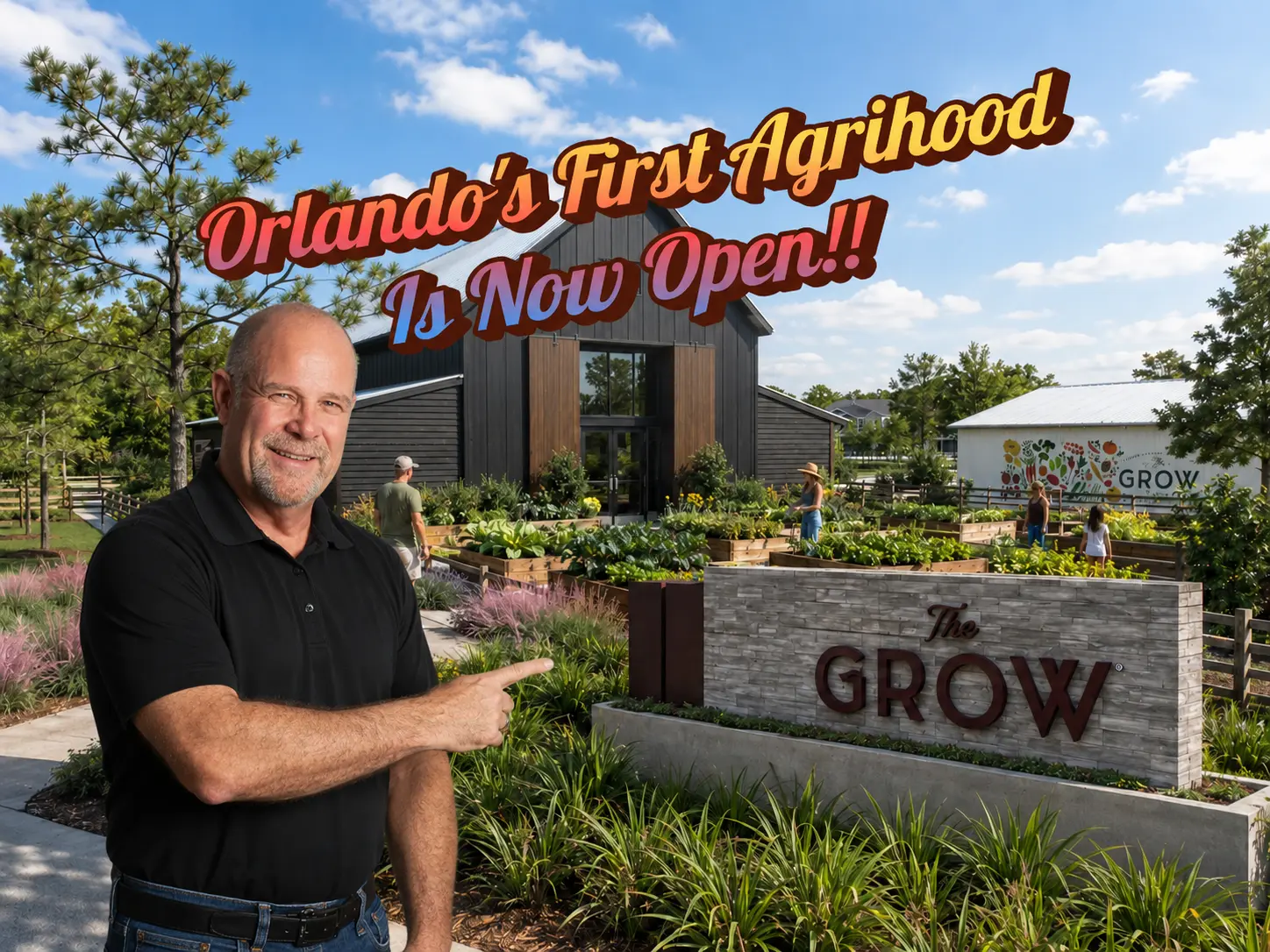
That changed in early 2026 when PulteGroup broke ground on The Grow, a 1,200-acre master-planned community in northeast Orange County built around a 9-acre working farm. It’s the first agrihood in Orlando, and Pulte’s first agrihood community anywhere in the country. Sales opened this spring, and it’s only just starting to get attention outside of new construction circles. This post is an attempt to fill that gap.
What Is an Agrihood, Exactly?
The Urban Land Institute defines an agrihood as a “single-family, multifamily, or mixed-use community built with a working farm or community garden as a focus.” The key word is “focus” — the farm isn’t an amenity bolted onto a standard subdivision. It’s the organizing concept the entire community is built around.
The concept has been growing nationally for about a decade. Agritopia in Gilbert, Arizona, is the most widely cited example — a community built around a working organic farm where residents can buy produce from the farm stand, eat at an on-site restaurant, and live in homes that face garden plots rather than streets. Prairie Crossing in Grayslake, Illinois, is another, built around 100 acres of protected farmland. According to the Urban Land Institute, there are now over 200 agrihoods across at least 30 states. The concept is real, it has staying power, and it tends to hold value well because it creates a genuinely differentiated community identity that most subdivisions can’t replicate after the fact.
What an agrihood is not: a community where someone planted raised beds near the mailboxes and called it farm-to-table living. At a real agrihood, the farm is professionally operated. Residents don’t have to grow anything — they benefit from the yields, the community programming, and the greenspace that a working agricultural operation creates around it. That distinction matters when you’re evaluating whether The Grow is the real thing or just a developer buzzword.
It’s the real thing.
The Basics: Size, Location, and What’s Being Built
The Grow sits on approximately 1,200 acres between Lake Pickett Road and State Road 50 (East Colonial Drive) in northeast Orange County, with convenient SR-408 access. That puts it squarely in the UCF and Central Florida Research Park corridor, roughly 20 minutes from Orlando International Airport and about 45 minutes from the Space Coast.
When complete, the community will include:
- Approximately 2,200 homes in a mix of townhomes, bungalows, and single-family detached homes
- A 9-acre working farm with barns, a farm stand, and event spaces
- 21 acres of community gardens and orchards
- A 20-acre community park
- 12 miles of recreational trails
- An equestrian facility
- A farm-to-table restaurant and welcome center
- Farmers’ market street
- Over 165,000 square feet of commercial space
- More than 200 acres of preserved wetlands and greenspace (roughly 60% of the total site)
- An elementary school campus with integrated agricultural education
The first phase is already underway, with 504 lots, the working farm infrastructure, two barns, and the farm stand all included in the initial buildout. Sales opened in spring 2026.
Home Types and Pricing
Pulte is offering three main product lines at The Grow, each designed to fit the farmhouse aesthetic of the broader community:
- The Aurora Series — professionally curated townhomes priced from the low $400s, with floor plans ranging from approximately 1,553 to 1,770 square feet
- The Ember Series — bungalow-style homes on 34-foot homesites, also from the mid-$400s
- Larger single-family homes on lots ranging from standard-width up to half an acre, with homes spanning 1,600 to over 4,200 square feet
Architecture throughout is vintage farmhouse in character — board-and-batten siding, metal roof accents, front porches, and the kind of detailing that tends to photograph well and hold up over time. It’s a departure from the stucco-and-tile aesthetic that dominates most of the Orlando market.
Who Is The Grow Built For?
The buyer profile at The Grow skews toward people who are drawn to the lifestyle concept more than a specific price point. Based on what Pulte has said publicly and what the site plan reveals, a few groups stand out:
- Families who want outdoor access, trail connectivity, and an agricultural education component for their kids built directly into the school campus next door
- UCF faculty, researchers, and employees at the Central Florida Research Park, for whom the location eliminates a commute problem entirely
- Buyers relocating from out of state who are specifically seeking something that doesn’t look or feel like a standard Florida subdivision
- Active adults and empty nesters who want walkability, green space, and a community built around health and sustainability rather than a golf course
What a Buyer’s Agent Actually Does at The Grow
Here’s a point worth making clearly: when you buy new construction at a Pulte community, the builder’s sales team represents Pulte. That’s their job. They’re excellent at it, and they know the product inside out. But they don’t represent your interests, negotiate on your behalf, or advise you on how a lot position, elevation premium, or upgrade package will affect your resale value down the road.
A buyer’s agent doesn’t add to your purchase price at The Grow. Pulte builds representation fees into their pricing model the same way every major national builder does. What you gain is someone in your corner during the contract review, the design center visit, and the pre-closing walkthrough — which is not a small thing on a new construction purchase.
We’ve covered the new construction agent question in more depth over on the Lofty side: will the builder give you a discount if you skip your agent? If you’re considering The Grow and want someone to walk through the process with you before you step into that sales center, schedule a no-pressure conversation here.
The Honest Caveats
No community is worth writing about if you’re not willing to say what it isn’t. A few things worth knowing before you make a trip out to the sales center:
- Orange County schools: The Grow is in Orange County, not Seminole County. Families who are prioritizing Seminole County Public Schools — Florida’s top-ranked district — should understand that this location zones to Orange County. OCPS is a large, capable district, and the on-site elementary school with agricultural programming is genuinely interesting — but it’s a different school system than Oviedo or Winter Springs.
- It’s still early: Phase one is just getting started. The farm-to-table restaurant, the full trail network, and the commercial amenities are years from completion. You’re buying into a vision and a construction timeline, not a finished community.
- SR-50 traffic: East Colonial is a real commute corridor. Access to I-408 helps, but this part of east Orange County has traffic patterns that reward early familiarity. Drive the route at rush hour before you commit.
- HOA structure is still forming: A community of this scope will have a homeowners association, and the fee structure, rules, and management details will matter over time. Confirm these details directly with the Pulte sales team before signing.
What is The Grow in Orlando?
The Grow is a master-planned agrihood community by PulteGroup located in northeast Orange County, just east of the University of Central Florida along State Road 50. When complete, it will include approximately 2,200 homes in a mix of townhomes, bungalows, and single-family detached homes, organized around a 9-acre working farm, 21 acres of community gardens, 12 miles of recreational trails, and over 200 acres of preserved wetlands and greenspace. It is Orlando’s first agrihood and Pulte’s first agrihood community nationally.
What is an agrihood?
An agrihood is a residential community built around a working farm or community garden as its central amenity and organizing concept. The Urban Land Institute defines it as a “single-family, multifamily, or mixed-use community built with a working farm or community garden as a focus.” At The Grow, the farm is professionally managed — residents do not need to tend crops — but they have access to the produce, the farm stand, and the planned farm-to-table dining concept on site.
How much do homes at The Grow cost?
As of spring 2026, prices at The Grow start from the low $400,000s for townhomes in the Aurora Series and from the mid-$400,000s for the Ember Series bungalows. Larger single-family homes on standard and estate lots are priced higher depending on size, lot position, and elevation. Pricing is subject to change as phases progress and inventory shifts. Contact Pulte directly or schedule a visit with a buyer’s agent to get current availability and pricing information.
What school district serves The Grow?
The Grow is located in Orange County, Florida, and is served by Orange County Public Schools (OCPS). Buyers who are specifically seeking Seminole County Public Schools — ranked #1 in Florida by Niche — should note that the county line places The Grow outside that district. The community does include an on-site elementary school campus with integrated agricultural education programming, which is a meaningful differentiator from a standard OCPS elementary assignment.
Do I need a buyer’s agent to buy at The Grow?
You are not required to bring a buyer’s agent, but there is no financial incentive to go without one. PulteGroup, like most major national homebuilders, incorporates buyer’s agent representation fees into their pricing model. Declining representation does not result in a lower purchase price — it simply means you navigate the contract, design center choices, and pre-closing walkthrough without independent representation. A buyer’s agent who works with new construction can be a meaningful advocate at those stages.
When will The Grow be finished?
The Grow is a multi-phase development planned across a 1,200-acre site. Phase one, which includes 504 lots and the initial farm infrastructure, broke ground in early 2026 with sales opening in spring 2026. Full buildout — including all 2,200 homes, the commercial district, farm-to-table restaurant, and complete trail network — is expected to take several years. Buyers considering early phases should understand they are purchasing into an active construction environment during that period.
Where exactly is The Grow located?
The Grow is located in northeast Orange County between Lake Pickett Road and State Road 50 (East Colonial Drive), east of the University of Central Florida. It has access to SR-408 (the East/West Expressway) and is approximately 20 minutes from Orlando International Airport and the new Brightline high-speed rail station. The Space Coast beaches are approximately 45 minutes away. UCF and the Central Florida Research Park are the closest major employment centers.
The Bottom Line
The Grow is genuinely different from anything else being built in the Orlando market right now. A 9-acre working farm at the center of a 1,200-acre master-planned community, 200 acres of preserved greenspace, 12 miles of trails, an integrated agricultural school curriculum, and farmhouse architecture throughout — that’s not a marketing brochure concept. That’s a real development thesis, and it’s being executed by one of the largest homebuilders in the country.
Whether it’s the right fit depends on what you’re actually optimizing for. If school district ranking is your primary variable, do your homework on OCPS zoning. If you want something with a distinctive lifestyle concept, proximity to UCF and the Research Park, and a community that’s being built around outdoor living and agricultural connection, The Grow is worth a serious look.
Explore current homes for sale in the east Orlando corridor, or take a read through our guide to the broader east Orlando area for more context on how The Grow fits into the larger map.
Ted’s Take
I’ve been watching The Grow come together for a while, and the concept is legitimately compelling in a way that doesn’t usually survive contact with Central Florida’s development machine. The farm is real. The preserved greenspace is real. The school integration is genuinely interesting for families. My honest take: if you want something that doesn’t look like every other east Orlando subdivision that went up between 2005 and 2022, The Grow is the most distinctive option in this corridor right now. Just go in with clear eyes about the OCPS school situation, the construction timeline, and SR-50 in the afternoon. The bones are good. The vision is good. The commute on Tuesday at 5pm is going to be what it is.
Ted Moseley is a Central Florida REALTOR® with Orlando Nest – Real Broker, LLC, helping buyers and sellers make clear, data-driven decisions across Orlando, Winter Park, Lake Nona, College Park, and surrounding neighborhoods.
Explore: Market Update · Home Value · Sell a Home · Reviews · More Articles
Have a question about timing, pricing, or next steps? Schedule a quick 30-minute call →
© Ted Moseley – Orlando Nest – Real Broker, LLC