
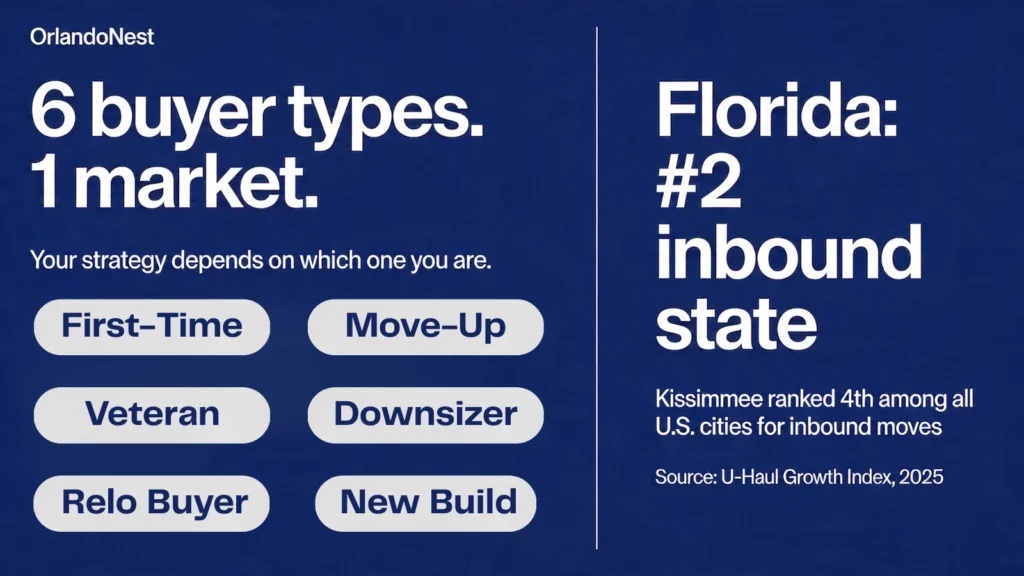
Orlando’s real estate market doesn’t operate on a single script. The strategy that works for a first-time buyer in Casselberry looks nothing like what makes sense for a physician relocating from Boston, a retiring couple eyeing something smaller in a 55+ community, or a veteran using a VA loan to buy in Oviedo. The market is the same. The decisions are not.
This hub is built for the full range of buyers who end up in Central Florida — with links to deeper resources for each situation. If you’re trying to figure out where you fit, start here.
Before You Start: Know Which Buyer You Are
Most buyer mistakes happen before a single offer is written. They come from applying the wrong framework — treating a relocation purchase like a traditional move-up, or approaching a downsizing decision with a first-timer’s checklist. Knowing which type of buyer you are shapes everything from how you structure your offer to what neighborhoods you should be evaluating first.
Central Florida has one of the most buyer-diverse markets in the country. Theme park economy workers, defense contractors from Lockheed and Siemens, healthcare professionals from the Lake Nona Medical City corridor, military families rotating through NAS Jacksonville or MacDill, and retirees migrating from the northeast all converge here. What they have in common is Orlando. What they need from the process is often very different.
First-Time Buyers: Build the Foundation Right
If this is your first purchase, the biggest mistake you can make is starting with the home search instead of the financial preparation. Pre-approval isn’t just a box to check — it tells you what you can actually qualify for, reveals any credit issues before they surface at the worst moment, and signals to sellers that your offer is real.
Florida has meaningful financial tools for first-time buyers that reduce the upfront cost of entry significantly. The Florida Hometown Heroes program — administered by the Florida Housing Finance Corporation — offers down payment assistance to qualifying buyers in essential workforce roles. Orange and Seminole County also run their own DPA programs with income-based eligibility. These aren’t obscure workarounds — they’re legitimate, widely used programs that your lender and agent should both know how to navigate.
| What first-time buyers should prioritize:Get pre-approved before touring homes — not afterAsk about Florida Hometown Heroes and county-level DPA programsReview down payment assistance options for Orlando buyersRun the rent vs. buy comparison honestly: does buying make more sense than renting right now?Understand that “as-is” doesn’t mean skip the inspection |
Move-Up Buyers: Coordinate the Timing
Move-up buyers — selling one home to buy the next — face a coordination problem that neither transaction alone would require. Do you list first and risk being homeless between closings? Accept a contingent offer that could fall through? Buy first and carry two mortgages? None of those options are inherently wrong. They’re tradeoffs, and which one makes sense depends on your equity position, the local inventory level, and your financial cushion.
In Orlando’s current market, with inventory shifting in several submarkets, timing matters more than it did in 2021. The move-up buyer who gets the sequencing right typically does it because they planned it — not because the market was forgiving.
| Move-up buyer considerations:Know your equity position before you start — get a home value estimateUnderstand bridge loans and sale-leaseback options if timing is tightContingent offers are more accepted now than they were 18 months ago — worth exploringYour listing strategy affects your buying leverage: a clean, priced-right sale gives you a stronger negotiating position on the buy side |
Downsizers: Right-Size Without Underselling the Lifestyle
Downsizing is often framed as giving things up. It doesn’t have to be. The best downsizing moves in Central Florida — from a large family home in Lake Mary into a well-located townhome in Winter Park, or from a four-bedroom in East Orlando into a golf-community villa in Dr. Phillips — are driven by intentional lifestyle design, not just square footage reduction.
The financial side is also worth thinking through carefully. If you’ve built significant equity over the years, the capital gains exclusion ($250,000 per individual / $500,000 for married couples on a primary residence) may apply. That’s a meaningful number to understand before you decide anything.
For buyers thinking about active adult communities specifically, we cover the full range of 55+ options in Central Florida in depth: Best 55+ Communities in Central Florida. The 55+ community search on orlandonest.com is also a good starting point for seeing what’s available.
Veterans and Military Buyers: Use the Benefit You’ve Earned
The VA home loan benefit is one of the most powerful financing tools available to any buyer — zero down payment, no private mortgage insurance, competitive rates, and no prepayment penalty. It’s also one of the most underutilized, largely because buyers don’t fully understand it or haven’t worked with a lender who knows the VA process.
Central Florida has a significant active duty and veteran population. Sellers in established neighborhoods understand VA financing. The stigma that VA offers are harder to get accepted has largely faded in this market, particularly with a pre-approval letter from a VA-experienced lender and an agent who can explain the appraisal process clearly.
| VA buyer checklist:Confirm your Certificate of Eligibility at va.gov/housing-assistance/home-loansWork with a VA-experienced lender — not all lenders are equally familiar with the processUnderstand the VA funding fee and any exemptions (disabled veterans often qualify)Review our VA and military buyer resources on orlandonest.com |
Relocation Buyers: Reduce the Unknowns
Relocating to Orlando from out of state — whether for a job, a lifestyle change, or a healthcare career opportunity — introduces a layer of uncertainty that local buyers don’t face. You’re evaluating neighborhoods you may have only seen on a weekend visit, commute times you haven’t tested, and school systems you’ve only researched online.
The most effective relocation buyers we work with do a few things consistently: they narrow to two or three submarkets before their visit rather than trying to tour everything, they make at least one trip during a weekday to test the actual commute, and they don’t let remote urgency push them into a purchase they haven’t thought through.
Our community guides are built specifically for buyers evaluating neighborhoods from a distance. Start with the communities most relevant to your situation: Baldwin Park, Dr. Phillips, Winter Park, Lake Nona, and College Park. The full relocation guide is also a good overview: 2026 Orlando Relocation Guide.
New Construction Buyers: Builder Incentives Aren’t Free Money
New construction communities are abundant in Central Florida — from entry-level product in Saint Cloud and Apopka to luxury builds in Lake Nona and Horizon West. Builders often offer rate buydowns, closing cost credits, and design center allowances. These incentives are real, but they come with conditions — using the builder’s preferred lender, accepting the builder’s contract (which favors the builder), and waiving some of the protections you’d expect in a resale transaction.
The short version: having your own representation costs you nothing as the buyer, and it matters more in a new construction deal than almost any other scenario. We break this down fully in Buying New Construction in Orlando.
Where to Go From Here
Use the community guides to narrow your neighborhood search. Use the posts above to go deeper on your specific buyer situation. And when you’re ready to talk through the details, schedule a conversation here — no pressure, no pitch, just a real conversation about what makes sense for you in this market.
Do I need a pre-approval before I start looking at homes in Orlando?
Yes — and not just as a formality. In Orlando’s competitive submarkets, listing agents will often ask for a pre-approval before scheduling showings on desirable properties. More importantly, the pre-approval process reveals your actual purchasing power, surfaces any credit issues that need to be resolved, and tells you which loan programs you qualify for — including down payment assistance. Starting the home search first and the pre-approval second is one of the most common mistakes first-time buyers make.
What is the Florida Hometown Heroes program and who qualifies?
The Florida Hometown Heroes program is a state-administered down payment assistance program for qualifying essential workers buying a primary residence in Florida. It’s open to a wide range of occupations — teachers, nurses, law enforcement, firefighters, and many others — and provides up to 5% of the loan amount as down payment assistance in the form of a second mortgage. Income and purchase price limits apply and vary by county. The program is run through the Florida Housing Finance Corporation and must be accessed through a participating lender. Both Orange and Seminole County also have their own DPA programs that may be stackable depending on circumstances.
What makes buying a home in Orlando different from buying in other Florida markets?
A few things stand out. Orlando’s growth is employment-driven — healthcare, defense, tourism, and tech — which creates year-round demand from relocation buyers rather than the seasonal patterns you see in coastal markets. That makes inventory and pricing more stable but also more competitive for well-located homes. The market is also unusually diverse by buyer type: first-timers, military families, retirees, and corporate relocations all compete in overlapping price bands. New construction is abundant but heavily concentrated in specific corridors (Horizon West, Saint Cloud, Apopka, parts of Lake Nona), which creates a two-speed market between established neighborhoods and new builds.
Can veterans use VA loans for new construction in Orlando?
Yes, but with some important caveats. VA loans can be used for new construction, but the builder must be VA-approved and the appraisal process is more involved than with resale. Some builders in Central Florida actively market to VA buyers and have streamlined processes for it. Others prefer conventional or FHA financing and may subtly steer VA buyers toward their preferred lender or discourage the process. Having a buyer’s agent familiar with VA transactions is important — they can help you evaluate whether a builder’s incentive package is genuinely competitive once you account for the loan type.
How should I approach a home search if I’m relocating to Orlando from out of state and can only visit once?
Narrow before you arrive. Most out-of-state buyers who try to tour everything in a weekend leave more confused than when they started. Pick two or three communities based on commute, school district, and lifestyle fit, and go deep on those rather than wide. Schedule at least one leg of the visit during a weekday commute window so you’re testing the actual drive, not the Saturday version. Use the community guides on The Perch to do that pre-work before you book the flight. And if you find something you like, be prepared to move quickly — waiting until you get home to “think about it” often means the property is gone.
What is the capital gains exclusion and does it apply when I downsize?
The IRS allows primary residence sellers to exclude up to $250,000 in capital gains from taxable income ($500,000 for married couples filing jointly), provided you’ve lived in the home as your primary residence for at least two of the last five years. For many long-term Orlando homeowners who have seen significant appreciation, this exclusion can eliminate or substantially reduce the tax liability from selling before downsizing. It’s not a real estate question — it’s a tax question — and a CPA familiar with Florida real estate should be part of your planning conversation before you list.
Do I still need a buyer’s agent if I’m buying new construction directly from a builder?
Yes — and this is one of the most important misconceptions in the Orlando new construction market. The sales agent at the model home works for the builder. Their job is to protect the builder’s interests, not yours. As a buyer, you can bring your own agent at no cost to you — the builder pays the buyer agent commission, and it’s built into the pricing regardless of whether you have representation. Your agent can review the builder contract (which is weighted in the builder’s favor), help you evaluate the incentive package, negotiate on upgrades, and advise on the inspection process for new construction.
Ted’s Take
I’ve worked with buyers in nearly every category on this page — first-timers who thought they needed 20% down (they didn’t), veterans who didn’t know their benefit covered a condo, retirees who bought too small because they were embarrassed to say they still wanted a guest room. The common thread isn’t the buyer type. It’s that the process goes better when you’re honest about what you actually need instead of optimizing for what you think sounds reasonable.
Orlando’s market is more nuanced than it gets credit for. Inventory is up in some pockets, tight in others. New construction is delivering product in corridors that didn’t exist five years ago. And the relocation wave isn’t slowing — which means well-located, well-priced homes still move quickly. Whatever kind of buyer you are, the strategy matters. Pick the right one.
Related Posts
-
Best Down Payment Assistance Programs for First-Time Home Buyers in Orlando (2026): Eligibility + How to Apply
A practical guide for Orlando first-time buyers — including Hometown Heroes — so you can reduce cash-to-close without stepping on any program landmines. Discover the best options for down payment assistance in Orlando. Orlando down payment assistanceFirst-time homebuyerHometown HeroesOrange CountyFlorida Housing Quick Summary: For most Orlando first-time buyers, the strongest down payment assistance options come […]
-
Orlando First-Timers: Cut Closing Costs 50%
My Proven Playbook Orlando’s Edge: Why 2026 Favors You Inventory climbs above buyer’s thresholds, so sellers offer concessions and flexibility. Average 30-year rates near low 6s mean lender credits and seller help directly impact your cash-to-close. Typical Orlando closing costs: 2-5% ($6K-$15K on $300K)—offset via lender perks, DPA, negotiations. Perfect timing for first-timers. (MIDFLORIDA, HomeLight) […]
-
Orlando First-Time Buyer Closing Costs Breakdown: Exact Fees and How to Negotiate Them Down
Orlando First-Time Buyer Closing Costs Breakdown: Exact Fees and How to Negotiate Them DownOrlando Real Estate • Buying Smarter Closing costs in Orlando are very real money (and yes, they show up with the confidence of someone who “just has a quick question” at 4:59 PM). The good news: in a buyer-leaning market, you can […]